
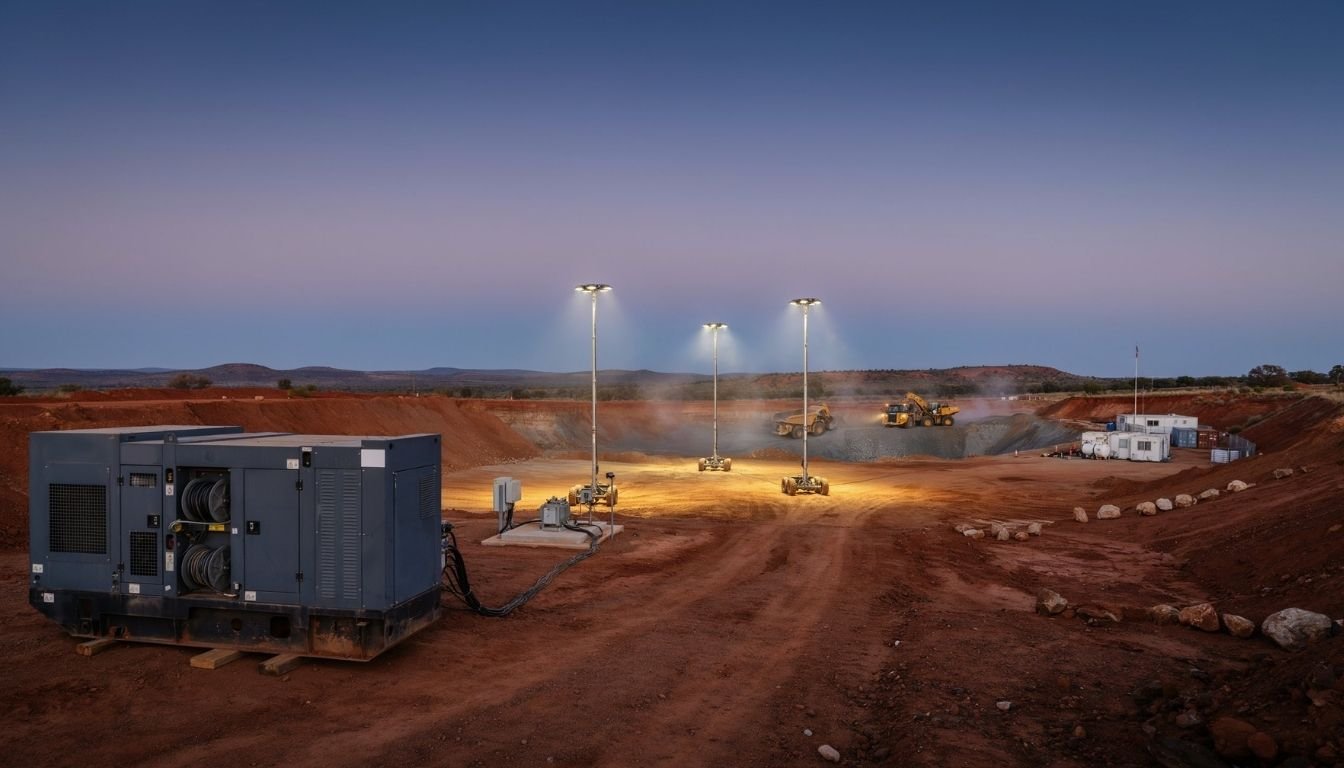
Reliable power and effective lighting are essential for mining operations across Australia. Remote mine sites, exploration camps, processing facilities and temporary work areas often depend on diesel generators and mobile lighting towers to maintain safe and productive working conditions.
When evaluating Desspower Australia mining projects generators lighting towers, buyers should look beyond equipment availability. Generator capacity, fuel consumption, operating hours, environmental protection and maintenance support all influence whether a solution will meet a project’s requirements.
The right equipment depends on the application. A generator supplying a remote accommodation camp has different requirements from one supporting heavy processing equipment. Similarly, a lighting tower used for routine site access may not provide sufficient illumination for detailed maintenance or equipment servicing.
Understanding these differences helps mining operators specify suitable equipment, control operating costs and reduce the risk of avoidable downtime.
Key Takeaways
- Mining projects need generators sized for actual electrical demand and operating conditions.
- Lighting towers must provide suitable illumination for specific work areas and night shifts.
- Remote sites require reliable fuel logistics, maintenance access and spare parts.
- Equipment specifications should match site safety requirements and environmental conditions.
- Project references and technical documentation help buyers verify supplier capabilities before committing.
How Generators Support Different Mining Operations
Mining projects use electrical power throughout exploration, construction, production and maintenance. Where a suitable grid connection is unavailable or unreliable, generators can provide temporary, standby or continuous power.
Exploration and Remote Drilling
Exploration programs frequently operate far from established infrastructure. Depending on the project, generators may supply power to drilling support equipment, field offices, accommodation units, communications systems and essential site facilities.
Equipment selection should account for:
- The combined electrical demand of connected equipment
- Motor starting currents and sudden load changes
- Daily operating hours and expected project duration
- Fuel storage and delivery access
- Transport limitations and available maintenance support
A compact generator may suit a small exploration camp, while a larger drilling operation may require multiple power sources or a more carefully engineered distribution system.
Mine Construction and Infrastructure Development
Construction phases often involve changing electrical loads as contractors install facilities, develop access roads and prepare production areas.
Generators may support welding equipment, temporary buildings, pumps, workshops and site services. Some applications benefit from separate generators for major equipment and general site loads because this can simplify load management and maintenance planning.
Temporary power requirements should be reviewed as construction progresses. A configuration suitable for early earthworks may not meet the needs of later installation and commissioning activities.
Processing Facilities and Production Areas
Processing operations can have demanding power requirements because motors, pumps, conveyors and other equipment may operate simultaneously.
A generator supplying these loads must be selected for more than its total nameplate capacity. Starting currents, load variation, power factor, harmonics and the consequences of a power interruption can all affect the specification.
For critical applications, engineers may consider multiple generators operating in parallel. This arrangement can provide additional capacity and operational flexibility, but it also introduces requirements for synchronization, load sharing, protection and control systems.
Choosing the Right Generator Capacity for a Mine Site
Generator sizing is one of the most important decisions in a remote power project. An undersized unit may experience overloads or voltage instability. An oversized unit can operate inefficiently when the electrical demand remains low.
Before selecting equipment, prepare a load schedule covering every significant electrical consumer.
The schedule should include running power, starting requirements, operating patterns and the priority of each load. Essential equipment should be distinguished from loads that can be temporarily disconnected during peak demand.
Generator Selection Factors
| Selection factor | Why it matters |
|---|---|
| Total connected load | Establishes the equipment that may need power at the same time |
| Starting current | Determines whether motors and other equipment can start without unacceptable voltage drops |
| Duty rating | Distinguishes standby use from prime or continuous operation |
| Ambient temperature | Can affect available generator output and cooling performance |
| Altitude | May reduce engine performance and require derating |
| Fuel consumption | Influences operating expenses and delivery schedules |
| Power quality | Helps protect sensitive controls and electronic equipment |
| Service access | Affects maintenance intervals, repair time and parts availability |
The final capacity should be confirmed through an engineering assessment rather than a simple addition of equipment nameplate ratings.
Prime Power Versus Standby Power
Prime-rated generators are intended for applications where the generator is a primary source of electricity under the manufacturer’s specified operating conditions. Standby generators are intended for emergency or backup applications and generally have different operating limitations.
These ratings are not interchangeable. Buyers should check the manufacturer’s duty definitions, allowable load profile and maintenance requirements before using a generator for extended operation.
For a remote mine that relies on generators every day, a standby-only unit may not be suitable for the intended duty.
Why Lighting Towers Matter on Mining Projects
Lighting towers support visibility across work areas that operate after dark or have limited permanent lighting. They are commonly used around access roads, maintenance zones, loading areas, temporary construction sites and selected outdoor work areas.
However, the presence of a lighting tower does not automatically mean that an area is adequately illuminated. Its suitability depends on light output, mounting height, beam distribution, tower placement and surrounding conditions.
LED Lighting Towers
LED lighting towers can provide efficient illumination with relatively low maintenance requirements for the lighting components. Their suitability depends on the actual light distribution and the conditions in which they operate.
Important specifications include:
- Total light output in lumens
- Mounting height and mast configuration
- Beam angle and light distribution
- Power consumption
- Operating duration
- Wind rating and structural stability
- Transport and deployment requirements
Lumens indicate the total amount of visible light produced. They do not establish how much light reaches a particular work surface.
For this reason, lighting plans should consider measured illuminance in lux at the working level. Detailed tasks may require different lighting conditions from general access routes or open storage areas.
Diesel, Solar and Hybrid Lighting Towers
Different tower types offer different advantages depending on the location and operating schedule.
| Lighting tower type | Main advantage | Important limitation |
|---|---|---|
| Diesel-powered LED | Can support extended operation where fuel is available | Requires fuel management and engine maintenance |
| Solar with battery storage | Can reduce fuel use and local engine emissions | Performance depends on stored energy, sunlight and lighting demand |
| Hybrid | Can combine battery operation with engine-supported charging | Requires suitable controls and a more detailed operating assessment |
A solar or hybrid unit may reduce fuel consumption in suitable conditions. However, the decision should account for overnight lighting demand, consecutive low-sunlight periods, battery capacity and the availability of backup charging.
For critical work areas, confirm that the proposed system can maintain the required illumination throughout the full shift.
What Mining Operators Should Verify Before Purchasing Equipment
Searching for Desspower Australia mining projects generators lighting towers may lead buyers to evaluate equipment suitability alongside supplier experience. These are separate questions. A technically suitable generator does not by itself establish that a supplier has completed comparable mining projects.
Before making a purchase or rental commitment, request evidence that addresses both equipment performance and project delivery capability.
Verify Project Experience
Ask for relevant project references that can be independently checked. Useful details include the type of operation, equipment configuration, operating environment and scope of work completed.
For any claimed mining project, confirm whether the supplier provided the equipment directly, arranged procurement, performed maintenance or delivered a complete engineered solution.
These distinctions help establish the supplier’s actual role.
Review Technical Documentation
Request the documentation needed to verify that the equipment matches the intended application.
Depending on the equipment, this may include:
- Manufacturer specifications and duty ratings
- Electrical drawings and connection requirements
- Load calculations and protection arrangements
- Fuel system capacity and operating limitations
- Maintenance schedules and parts information
- Lighting performance data and photometric reports
- Relevant inspection, testing and compliance records
Documents should identify the actual model and configuration being offered. General product brochures may not establish that a particular unit is suitable for the proposed site.
Confirm Service and Parts Availability
A remote location can make a relatively minor mechanical or electrical fault expensive if replacement parts or qualified technicians are difficult to access.
Clarify who will perform maintenance, where parts will be sourced and how breakdowns will be handled. Also establish which responsibilities belong to the equipment supplier and which remain with the mine operator or site contractor.
The support arrangement should match the consequences of equipment failure, not simply the purchase price.
Managing Generator and Lighting Tower Costs Across the Project Lifecycle
The initial equipment price is only one part of the total cost of ownership. Fuel, servicing, transport, installation, consumables and downtime can have a substantial effect on the overall project budget.
For long-duration mining work, compare alternatives using the same operating assumptions.
A useful cost assessment includes:
- Equipment purchase or rental charges
- Expected operating hours
- Fuel consumption under the actual load profile
- Scheduled servicing and replacement parts
- Mobilization, transport and installation
- Fuel storage and delivery arrangements
- Backup equipment and redundancy requirements
- Costs associated with unplanned downtime
Avoid relying on a manufacturer’s best-case fuel figure without checking the test conditions. Actual consumption varies with load, ambient conditions, equipment condition and operating practices.
For lighting towers, compare the cost of supplying the required illumination over a complete shift rather than comparing equipment prices or lumen ratings alone.
Safety and Environmental Requirements for Remote Mine Sites
Mining equipment must suit the hazards and operating conditions of the site. A general-purpose generator or lighting tower should not be assumed to meet every mine’s requirements.
The project team should review applicable state or territory mining legislation, site procedures, electrical requirements and equipment-specific obligations before commissioning.
Generator Safety
Key considerations include ventilation, exhaust discharge, hot surfaces, electrical protection, grounding arrangements and access for maintenance. Fuel systems may require suitable containment and controls to manage leaks and spills.
Generators should be positioned to limit exposure to exhaust fumes and excessive noise while maintaining safe access for inspections and servicing.
Electrical connections and protective devices must be appropriate for the installation and intended use.
Lighting Tower Safety
Lighting towers need stable positioning and suitable deployment arrangements for the terrain and weather conditions.
Operators should confirm mast operating limits, wind restrictions, lifting points, transport restraints and safe access around the unit. Light placement should also minimize glare and avoid creating shadows that interfere with equipment operators.
Maintenance should follow the manufacturer’s instructions, including safe isolation procedures before work begins.
Environmental Performance
Fuel-efficient engines, LED lighting, battery storage and hybrid systems may help reduce fuel use or emissions when selected for appropriate applications.
The actual benefit depends on duty cycle, energy demand, weather conditions and maintenance practices. Environmental claims should be supported by comparable operating data rather than assumed from the equipment category alone.
How to Select a Solution for Your Mining Project
The best configuration depends on the site’s electrical demand, lighting requirements, project duration and tolerance for downtime.
Use the following framework to compare available options.
| Project requirement | Preferred approach to evaluate |
|---|---|
| Short exploration campaign | Mobile equipment with straightforward deployment and manageable fuel logistics |
| Long-term remote camp | Prime-rated generation sized for the expected load profile and service schedule |
| Large processing operation | Engineered generation with suitable load management and protection |
| Critical electrical loads | A redundancy and backup strategy based on the consequences of failure |
| Nighttime construction | Lighting towers selected through a task-specific lighting assessment |
| Long-duration outdoor lighting | Compare diesel, solar and hybrid systems using full-shift energy demand |
| Difficult remote access | Prioritize transport compatibility, parts availability and practical field service |
Build a Project Specification Before Requesting a Quote
A useful equipment request should identify the operating conditions rather than simply asking for a generator or lighting tower.
Include the following information:
- Site location and access restrictions.
- Equipment to be powered and estimated electrical demand.
- Starting loads and expected load changes.
- Required operating hours and project duration.
- Environmental conditions and site-specific safety requirements.
- Fuel supply, storage and delivery arrangements.
- Lighting tasks, working areas and required illumination.
- Maintenance expectations and acceptable downtime.
- Delivery schedule, commissioning needs and available technical support.
This information allows suppliers to respond with more relevant equipment configurations and makes competing quotations easier to compare.
For buyers assessing Desspower Australia mining projects generators lighting towers, request model-specific specifications and verifiable project references alongside the commercial quotation. The strongest choice is the one that meets the site’s technical requirements and has a practical support plan for the entire operating period.
Frequently Asked Questions
What types of generators are used on Australian mining projects?
Mining operations may use diesel generators for exploration, accommodation camps, construction, processing support and backup power. The required size and configuration depend on electrical demand, duty cycle, site conditions and the consequences of a power interruption.
How do mining operators choose a suitable lighting tower?
Operators should assess the work being performed, required illuminance, light distribution, operating hours, weather exposure and relocation frequency. A photometric assessment can help confirm whether the proposed tower arrangement provides adequate illumination.
Are solar lighting towers suitable for remote mine sites?
They can be suitable where battery capacity, available sunlight and the required lighting schedule align. Sites requiring uninterrupted overnight lighting should assess consecutive low-sunlight periods and determine whether backup charging or hybrid operation is necessary.
What should buyers ask about Desspower Australia mining projects generators lighting towers?
Buyers should request the proposed equipment models, technical specifications, operating limitations, maintenance arrangements and relevant mining project references. Any claimed project experience should be verified, including the supplier’s actual role and the configuration delivered.
Is buying or renting a generator better for a mining project?
Rental may suit short campaigns, temporary construction and uncertain equipment demand. Purchasing may be worth evaluating for long-term use where utilization is high and the operator can manage maintenance, servicing and asset ownership. Compare the full cost over the expected project duration before deciding.
Why is generator maintenance important at remote mine sites?
Preventive maintenance helps identify developing faults, protect equipment performance and reduce avoidable interruptions. Remote operations also need suitable spare parts, trained personnel and maintenance intervals that reflect actual operating conditions.
What information is needed to obtain a generator or lighting tower quotation?
Provide the site location, required capacity, load profile, operating schedule, lighting requirements, environmental conditions, delivery timeline and support expectations. More complete specifications reduce uncertainty and help suppliers recommend equipment that fits the project.