
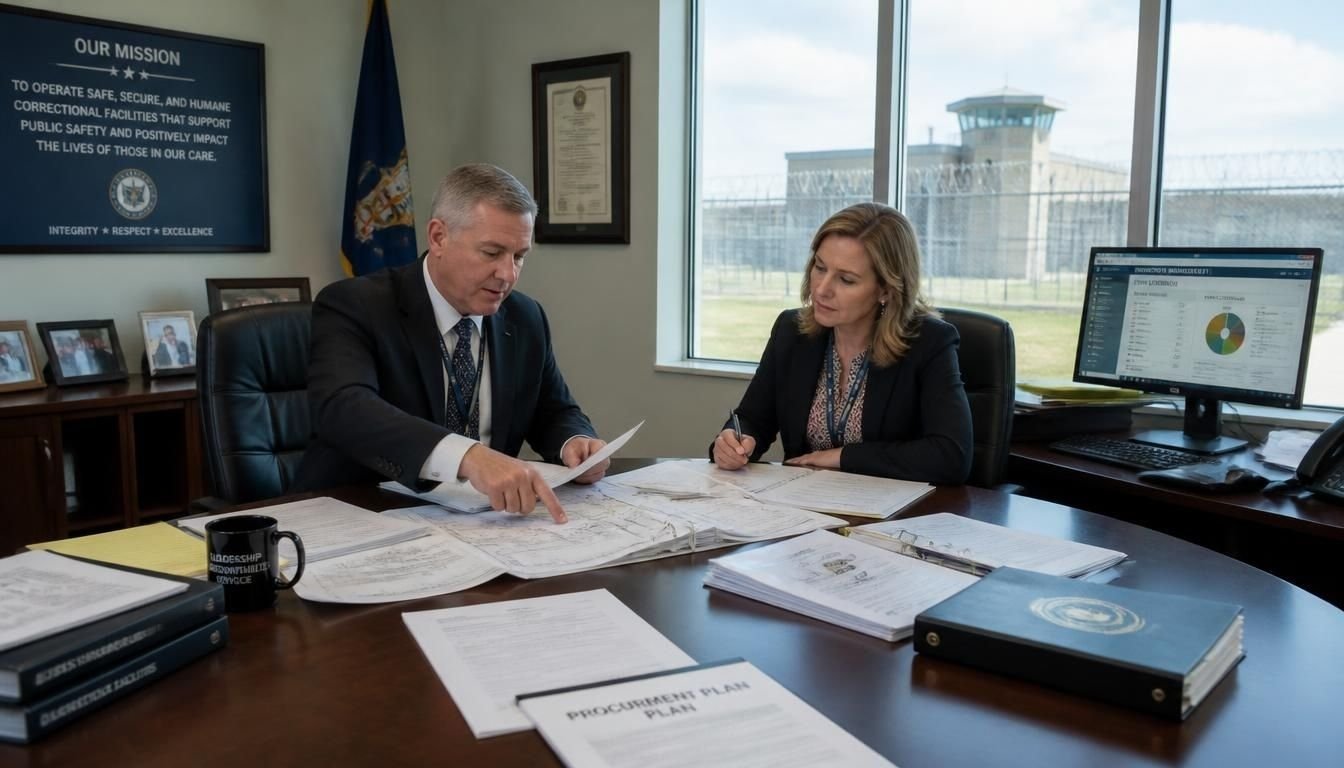
Correctional facilities require more than security staff and physical infrastructure to operate effectively. Their daily operations depend on an organized administrative structure strong leadership and controlled purchasing procedures.
Understanding correctional facility structure leadership procurement processes helps vendors government contractors administrators and organizations working with correctional institutions understand who makes decisions how purchasing authority is assigned and how products and services are approved.
In the United States these arrangements vary between federal prisons state correctional institutions and county or municipal jails. A federal facility generally follows the organizational policies of the Federal Bureau of Prisons. State prisons operate under their respective departments of corrections while local jails may report to a sheriff or county government.
Although their reporting structures differ their core administrative responsibilities are similar. Each facility needs clear operational leadership financial oversight procurement controls and accountability for the resources used to maintain daily operations.
How Correctional Facilities Are Organized in the United States
A correctional facility operates within a larger government organization. Its structure determines who establishes policies who supervises employees and who has authority over operational and financial decisions.
The organizational model depends on the type of institution and the government agency responsible for it.
Federal Correctional Facilities
Federal prisons operate under the Federal Bureau of Prisons (BOP), which is part of the U.S. Department of Justice.
The BOP uses a multi-level administrative structure that connects individual institutions with regional oversight and national leadership.
Its main organizational levels include:
- National leadership: Establishes agency priorities and oversees nationwide operations.
- Central administration: Manages specialized functions such as finance procurement human resources healthcare and correctional programs.
- Regional offices: Provide oversight and administrative support to assigned institutions.
- Individual facilities: Manage daily operations under local institutional leadership.
The Administration Division has responsibility for budget development financial management procurement property and facility management. This includes planning new institutions and maintaining existing facilities.
State Correctional Facilities
Each state operates its own correctional system through a Department of Corrections or an equivalent government agency.
The state organizational structure generally includes:
- Governor or state executive authority
- Department of Corrections Director
- Deputy Directors or Assistant Directors
- Regional administrators
- Wardens or facility superintendents
- Department heads and operational supervisors
The Director oversees the department’s overall administration and strategic planning. Correctional facility administrators manage individual institutions and report through the department’s established chain of command.
For example a state system may separate correctional facility administration from field operations and budget administration. This allows specialized teams to manage different responsibilities without placing every decision under an individual facility.
County and Municipal Jails
Local jails generally operate under county or municipal government authority.
Depending on the jurisdiction the facility may report to:
- An elected county sheriff
- A county corrections department
- A local government corrections administrator
- A municipal public safety department
The sheriff or appointed jail administrator may have responsibility for daily operations staffing security and institutional management.
Local jails also coordinate with courts law enforcement agencies healthcare providers and county financial departments.
Unlike state and federal prisons local jails frequently manage short-term detention and individuals awaiting court proceedings. Their operational requirements can therefore differ considerably.
Key Leadership Positions and Their Responsibilities
Leadership positions within correctional institutions are designed to establish clear responsibility for security administration personnel and financial management.
Although job titles vary between jurisdictions the following positions are common across many correctional systems.
Director of Corrections
The Director of Corrections provides executive leadership for a state correctional department.
Typical responsibilities include:
- Establishing department-wide policies and operational priorities.
- Managing institutional performance.
- Overseeing department budgets and resource allocation.
- Coordinating with state government officials.
- Supervising senior administrative leadership.
- Ensuring compliance with applicable laws and regulations.
The Director generally does not manage every purchase or operational decision at individual facilities. Instead the position establishes broader authority and oversight.
Warden or Facility Superintendent
The warden is generally the highest-ranking administrator at an individual prison.
The position carries responsibility for the institution’s overall operation.
Major responsibilities include:
- Maintaining institutional security.
- Supervising department heads and facility managers.
- Managing staffing and operational resources.
- Monitoring facility budgets.
- Coordinating maintenance and infrastructure requirements.
- Reviewing significant operational concerns.
- Ensuring institutional policies are followed.
A warden may approve operational requests within delegated authority. However approval of a purchase does not automatically give the warden authority to execute a government contract.
That distinction is important when dealing with correctional facility purchasing departments.
Deputy Warden or Assistant Superintendent
Deputy wardens support the facility’s senior administrator and may oversee specific operational divisions.
Common areas of responsibility include:
- Security and custody operations.
- Programs and inmate services.
- Administrative services.
- Facility maintenance.
- Staff supervision and scheduling.
The deputy warden may review departmental requirements and coordinate operational priorities before they reach the warden or another authorized decision-maker.
Chief Financial Officer or Business Administrator
Financial administrators oversee the facility’s financial activities and resource management.
Their responsibilities may include:
- Budget planning and expenditure monitoring.
- Reviewing available funding.
- Coordinating purchase requests.
- Maintaining financial records.
- Supporting audits.
- Monitoring contract expenses.
In smaller facilities these responsibilities may be assigned to a business manager or county finance office rather than a dedicated CFO.
Procurement and Purchasing Manager
The procurement manager coordinates purchasing activities and ensures that requests follow applicable government purchasing requirements.
Responsibilities can include:
- Reviewing purchase requisitions.
- Coordinating quotations and competitive solicitations.
- Preparing procurement documentation.
- Monitoring purchasing activities.
- Coordinating with vendors and contractors.
- Maintaining purchasing records.
- Supporting contract administration.
The procurement manager may have authority to conduct purchasing activities but not necessarily the authority to sign every contract. Contract execution depends on the jurisdiction’s delegated authority and approval requirements.
Departments That Influence Facility Purchasing Decisions
Correctional facilities purchase products and services for many operational areas. The department requesting an item is usually different from the department responsible for purchasing it.
Understanding this distinction helps explain how purchasing decisions move through an institution.
| Department | Main responsibility | Typical purchasing requirements |
|---|---|---|
| Security and custody | Institutional safety and supervision | Security equipment and approved supplies |
| Facilities and maintenance | Building operations and repairs | HVAC parts plumbing electrical supplies |
| Food services | Meal preparation and distribution | Food products kitchen equipment and supplies |
| Healthcare services | Medical and mental health support | Medical equipment healthcare supplies and services |
| Information technology | Technology infrastructure | Computers software networking and security systems |
| Administration | Financial and operational support | Office equipment furniture and administrative supplies |
| Transportation | Institutional transportation | Vehicle maintenance parts and approved equipment |
| Laundry and housekeeping | Cleaning and clothing services | Cleaning products laundry equipment and linens |
These departments identify their operational requirements and provide supporting information to the purchasing function.
For example a maintenance supervisor may identify the need for a replacement HVAC component. The supervisor explains the technical requirements and operational urgency. The purchasing department then determines how the item can be acquired under the applicable procurement rules.
This separation helps prevent individual departments from making unauthorized purchasing commitments.
How Correctional Facility Procurement Processes Work
Procurement in a correctional institution involves more than selecting a supplier and issuing a purchase order.
It is a controlled process that connects operational requirements with funding approval vendor selection purchasing authority and contract management.
Federal and state institutions follow different procurement frameworks. Federal Bureau of Prisons acquisitions are governed by the Federal Acquisition Regulation (FAR), Department of Justice Acquisition Regulations and Bureau of Prisons acquisition policies.
State and local institutions follow their respective government purchasing laws and administrative procedures.
Step 1: Identify an Operational Requirement
The process begins when a department identifies a need for a product service or equipment.
Examples include:
- Replacement security equipment.
- Food service supplies.
- Medical equipment.
- Building maintenance services.
- Cleaning products.
- Technology upgrades.
- Vehicle repair services.
The requesting department must explain what it needs and why the purchase is necessary.
A strong request identifies the required specifications intended use quantity and operational urgency.
Step 2: Prepare a Purchase Requisition
The requesting department submits a purchase requisition through the facility’s approved purchasing system.
The requisition usually contains:
- Description of the requested product or service.
- Quantity and technical specifications.
- Estimated cost.
- Required delivery date.
- Department and budget information.
- Business justification.
- Supporting documentation.
The requisition creates a formal record of the purchasing request.
It should not be confused with a purchase order. A requisition requests authorization to buy while a purchase order is an official purchasing document issued through the authorized process.
Step 3: Review Budget Availability
The financial or budget department determines whether funding is available.
This review may involve checking:
- Departmental budget allocations.
- Remaining operating funds.
- Approved capital expenditure budgets.
- Existing contract commitments.
- Applicable funding restrictions.
If funding is unavailable the request may need additional approval or a revised scope.
For example a facility may need new kitchen equipment but have limited maintenance funding. The financial administrator may need to determine whether the purchase qualifies for another approved budget category.
Step 4: Determine the Appropriate Procurement Method
Once the requirement and funding are reviewed the procurement team determines how to acquire the product or service.
Depending on the purchase value and applicable rules the method may include:
Existing government contracts
The institution may purchase through an existing government-wide or state-approved agreement if it is authorized to use that contract.
Competitive quotations
The procurement team may request pricing from multiple qualified vendors when permitted or required by purchasing rules.
Formal bidding
Larger purchases or contracts may require a formal solicitation with defined specifications submission deadlines and evaluation criteria.
Request for Proposals
An RFP may be appropriate when the agency needs to evaluate technical capabilities service quality implementation plans and pricing rather than selecting solely on the lowest price.
Authorized exceptions
Some circumstances may permit noncompetitive purchasing under specific legal and administrative conditions. These exceptions generally require appropriate justification and documentation.
The correct method depends on the procurement authority and applicable thresholds rather than a universal purchasing limit.
Step 5: Evaluate Vendors and Proposals
When competitive purchasing is required the procurement team evaluates submissions according to the established solicitation requirements.
Evaluation factors may include:
- Compliance with technical specifications.
- Product quality and suitability.
- Total evaluated cost.
- Vendor qualifications.
- Delivery capacity.
- Previous contract performance.
- Warranty and maintenance support.
- Required security and regulatory compliance.
For correctional facilities the lowest purchase price may not represent the best overall value.
A product that fails to meet security requirements or cannot be maintained reliably may create additional costs and operational problems.
Step 6: Obtain Final Approvals and Award the Contract
After evaluation the responsible procurement officials complete the required approval and award procedures.
Depending on the institution the approval process may involve:
- Procurement management.
- Budget or finance officials.
- Facility leadership.
- Department-level administrators.
- Legal counsel.
- Authorized contracting officers.
- State or county purchasing authorities.
The individual authorized to approve an operational need may not be the same person authorized to sign the contract.
This distinction is particularly important for suppliers negotiating with public correctional institutions.
Step 7: Issue the Purchase Order and Receive the Goods
After the necessary approvals and contract requirements are completed the authorized purchasing office issues the purchase order or other applicable purchasing document.
The vendor then follows the agreed delivery requirements.
Receiving personnel verify:
- Product description and quantity.
- Delivery condition.
- Compliance with specifications.
- Required documentation.
- Any discrepancies or damaged items.
Items that do not meet the purchase requirements may need to be rejected returned or replaced.
Step 8: Verify Invoices and Maintain Records
The facility verifies the invoice against the purchasing documentation and receiving records.
This process helps confirm that:
- The purchase was authorized.
- The correct goods or services were delivered.
- The agreed prices were charged.
- The invoice matches the purchase order.
- Required receiving documentation is available.
Financial personnel then process payment according to applicable procedures.
Maintaining requisitions purchase orders receiving reports invoices and contract records also supports financial audits and future purchasing decisions.
Procurement Responsibilities and Approval Stages
The following table summarizes a typical purchasing workflow. Actual authority and approval requirements vary by government agency.
| Procurement stage | Primary responsible party | Main output |
|---|---|---|
| Requirement identification | Requesting department | Defined operational need |
| Purchase requisition | Department supervisor | Formal purchasing request |
| Budget review | Finance department | Funding confirmation |
| Procurement method | Purchasing office | Approved purchasing approach |
| Vendor evaluation | Procurement evaluation team | Evaluation results |
| Contract approval | Authorized officials | Contract authorization |
| Purchase order | Authorized purchasing office | Official purchase order |
| Receiving and inspection | Receiving department | Delivery verification |
| Invoice processing | Finance or accounts payable | Payment processing |
| Contract monitoring | Contract administrator | Performance records |
Who Has Authority to Approve Purchases in a Correctional Facility?
One of the most important aspects of correctional facility structure leadership procurement processes is understanding the difference between operational approval and purchasing authority.
Several individuals may participate in a purchase without having the legal authority to authorize the final transaction.
Operational Approval
The department supervisor or facility manager identifies the need and confirms that the requested product or service supports institutional operations.
For example a food services manager may approve the operational need for replacement kitchen equipment.
Budget Approval
The finance department verifies that funding is available and that the expense is appropriate for the relevant budget.
Procurement Approval
The procurement office determines whether the proposed purchasing method follows applicable government procedures.
Contract Approval
An authorized contracting officer or designated government official approves and executes the contract within their delegated authority.
Final Administrative Oversight
The warden department director sheriff or another senior administrator may provide additional approval depending on the facility’s policies and purchasing thresholds.
Important distinction: A warden may request or approve the need for equipment without personally controlling the procurement process or signing the resulting contract.
This is why vendors should identify the correct purchasing authority instead of assuming that the facility’s highest-ranking administrator handles every purchase.
What Vendors Need to Know Before Working With Correctional Facilities
Selling products or services to correctional institutions involves a different purchasing environment from working with private businesses.
Government agencies must follow established procurement requirements and maintain documentation supporting their purchasing decisions.
Businesses interested in supplying correctional facilities should understand several important considerations.
Identify the Correct Purchasing Channel
Start by determining whether the facility purchases directly or through a centralized government procurement department.
For example:
- Federal prisons generally use established federal acquisition procedures.
- State prisons may purchase through a centralized Department of Corrections procurement office.
- County jails may work through a sheriff’s office or county purchasing department.
- Some facilities may use existing cooperative purchasing agreements.
A supplier should not assume that every correctional institution has independent purchasing authority.
Understand Vendor Registration Requirements
Some government agencies require businesses to register before participating in purchasing opportunities.
Depending on the contract this may involve:
- Government vendor registration.
- Tax and business documentation.
- Insurance certificates.
- Required certifications.
- Product compliance documentation.
- Financial or business qualification information.
Federal contracting opportunities may also require registration in the System for Award Management (SAM.gov).
However registration requirements differ between federal state and local purchasing systems.
Prepare Detailed Product Specifications
Correctional facilities often require products that meet specific operational and security requirements.
A supplier should be prepared to provide:
- Product descriptions.
- Technical specifications.
- Product dimensions.
- Material information.
- Warranty details.
- Maintenance requirements.
- Delivery information.
- Pricing documentation.
For example a supplier offering institutional furniture may need to demonstrate that the proposed products meet the facility’s applicable durability and safety requirements.
A general product catalog may not provide enough information for a formal procurement evaluation.
Understand Delivery and Facility Access Requirements
Correctional facilities operate under controlled security procedures.
Delivery arrangements may require:
- Advance scheduling.
- Approved delivery personnel.
- Vehicle and identification checks.
- Inspection of incoming products.
- Restricted delivery locations.
- Compliance with facility security instructions.
Suppliers should confirm these requirements before committing to delivery dates or transportation arrangements.
Review Contract Performance Requirements
Winning a contract is only one part of the business relationship.
Suppliers may also need to meet ongoing obligations involving:
- Delivery schedules.
- Product quality.
- Service response times.
- Maintenance support.
- Replacement procedures.
- Reporting requirements.
- Contract renewal conditions.
Failure to meet contractual requirements can affect future purchasing opportunities.
Common Procurement Challenges in Correctional Institutions
Correctional facilities face operational challenges that can make procurement more complicated than ordinary commercial purchasing.
Balancing Security With Purchasing Efficiency
Security requirements can limit which products vendors may deliver and which contractors may access institutional facilities.
Purchasing teams must evaluate whether proposed products and services meet operational and security requirements before proceeding.
Managing Urgent Maintenance Requirements
Equipment failures involving HVAC systems plumbing electrical infrastructure or kitchen operations can affect the facility’s ability to maintain normal services.
Procurement teams must balance urgent operational requirements with applicable purchasing rules.
An emergency does not automatically eliminate procurement requirements. Any permitted emergency purchasing method must follow the relevant authority and documentation procedures.
Preventing Budget Overruns
Facilities manage multiple operational departments with competing resource requirements.
Without effective financial oversight departments may submit duplicate requests or purchase items that do not align with approved budgets.
Centralized expenditure monitoring helps identify unnecessary purchases and maintain financial accountability.
Maintaining Vendor Performance
A supplier may offer competitive pricing but struggle with delivery schedules product quality or ongoing support.
Facilities need documented performance monitoring to determine whether vendors are meeting contractual requirements.
This is particularly important for recurring services such as food management healthcare maintenance and equipment support.
Maintaining Accurate Procurement Records
Incomplete records can make it difficult to verify purchasing decisions and investigate financial discrepancies.
Procurement offices should maintain organized records covering:
- Purchase requests.
- Approval documentation.
- Vendor quotations.
- Evaluation records.
- Contracts.
- Purchase orders.
- Delivery confirmations.
- Invoices.
- Contract performance reviews.
How to Evaluate a Correctional Facility’s Purchasing Structure
Organizations working with correctional facilities need to understand how purchasing authority is distributed before pursuing a contract or proposing a supplier relationship.
The most effective approach is to evaluate the institution’s structure funding authority procurement method and operational requirements together.
1. Determine Whether Purchasing Is Centralized or Facility-Based
There are two common purchasing arrangements.
Centralized procurement
A central government department manages purchasing for multiple institutions.
Advantages include:
- Consistent purchasing procedures.
- Greater control over government spending.
- Consolidated purchasing opportunities.
- Standardized contracts.
- Centralized vendor management.
The potential disadvantage is that individual facilities may have less flexibility when responding to specific operational requirements.
Facility-based procurement
Individual institutions handle certain purchasing activities within their delegated authority.
Advantages include:
- Better understanding of local operational needs.
- Potentially faster purchasing decisions.
- Direct communication between departments and purchasing personnel.
However individual facilities still need to comply with government purchasing requirements and approval restrictions.
2. Identify the Actual Decision-Makers
Do not assume that the warden is the only person involved in a purchasing decision.
Identify the individuals responsible for:
| Decision | Position to investigate |
|---|---|
| Identifying operational needs | Department supervisor |
| Approving facility requirements | Warden or authorized administrator |
| Confirming available funding | Budget or finance manager |
| Managing purchasing procedures | Procurement manager |
| Evaluating technical requirements | Relevant department specialists |
| Executing contracts | Authorized contracting officer |
| Monitoring vendor performance | Contract administrator |
The exact arrangement should be confirmed with the relevant agency.
3. Evaluate the Type of Purchase
Different purchasing categories require different levels of review.
For example:
- Routine supplies may be purchased through existing contracts.
- Specialized equipment may require technical evaluations.
- Building renovations may require formal project planning and construction procurement.
- Healthcare services may require extensive contract and performance oversight.
- Security-related products may require additional institutional review.
A supplier should understand these differences before preparing a proposal.
4. Compare Purchasing Channels
A correctional facility may have access to several purchasing options.
| Purchasing channel | Best suited for | Important consideration |
|---|---|---|
| Direct agency solicitation | Specific institutional requirements | Follow the agency’s bidding procedures |
| Statewide contracts | Recurring approved products and services | Check authorized purchasing eligibility |
| Cooperative purchasing | Eligible government entities seeking shared agreements | Confirm participating state authorization |
| Federal contracts | Federal agency requirements | Meet applicable federal acquisition rules |
| Local government purchasing | County and municipal requirements | Follow local purchasing policies |
Cooperative purchasing can be particularly useful for suppliers targeting multiple public institutions.
For example NASPO ValuePoint maintains a correctional facilities products and supplies portfolio. However public entities must verify their eligibility and applicable state participating agreements before purchasing through it.
5. Evaluate the Best Entry Point for a Supplier
A supplier should choose its approach according to the product or service being offered.
For routine supplies: Investigate existing government contracts and purchasing arrangements.
For specialized equipment: Identify the department responsible for technical specifications and product evaluation.
For maintenance and construction: Determine the facility’s facilities management structure and relevant capital procurement requirements.
For contracted services: Review the agency’s solicitation requirements and contract performance expectations.
For nationwide opportunities: Research federal state and cooperative purchasing channels separately.
The best approach is not necessarily to contact the highest-ranking administrator. It is to identify the department that owns the requirement and the procurement authority that controls the purchasing process.
FAQs About Correctional Facility Structure and Procurement
1. What is the organizational structure of a correctional facility?
A correctional facility typically operates through a hierarchy consisting of a warden or jail administrator department heads supervisors and operational employees. The facility reports to a larger government authority such as a state Department of Corrections county sheriff or the Federal Bureau of Prisons.
2. Who is responsible for managing a correctional facility?
A warden generally manages an individual prison while a jail administrator or sheriff oversees local jail operations. Their responsibilities include institutional security staffing administration resource management and compliance with applicable policies.
3. Who controls procurement in a correctional facility?
Procurement may be managed by a centralized government purchasing department or an institution-level purchasing office. The procurement manager coordinates purchasing activities while authorized contracting officials approve transactions within their delegated authority.
4. How do correctional facilities purchase equipment and supplies?
Facilities generally identify an operational need prepare a purchase requisition verify funding select an appropriate purchasing method evaluate vendors obtain required approvals and issue a purchase order. Receiving and invoice verification follow delivery.
5. What regulations govern correctional facility procurement processes?
Federal correctional acquisitions follow the Federal Acquisition Regulation and applicable Department of Justice and Bureau of Prisons policies. State and local institutions follow their respective procurement laws administrative regulations and purchasing policies.
6. Can a warden approve purchases directly?
A warden may approve operational requirements or purchases within delegated authority. However the authority to issue purchase orders or execute contracts may belong to a separate procurement office or authorized contracting official.
7. How can businesses become suppliers to correctional facilities?
Businesses can investigate government procurement portals existing contracts and public solicitations. They should prepare appropriate vendor documentation product specifications pricing information and any required certifications before participating in purchasing opportunities.
8. What is the difference between centralized and facility-based procurement?
Centralized procurement is managed by a government department serving multiple institutions. Facility-based procurement allows individual institutions to handle purchases within their delegated authority. Both arrangements must follow applicable purchasing requirements.
9. Why are procurement records important in correctional institutions?
Procurement records establish a documented history of purchasing requests approvals vendor evaluations contracts deliveries and payments. They support financial accountability audits contract monitoring and future purchasing decisions.
10. How do correctional facility structure leadership procurement processes affect vendors?
These processes determine who identifies purchasing needs who evaluates suppliers who approves funding and who can execute contracts. Understanding the organizational hierarchy helps vendors approach the correct department and follow the appropriate purchasing channel.
Understanding the Connection Between Leadership and Procurement
Effective correctional facility management depends on a clear relationship between institutional leadership financial oversight and purchasing authority.
The warden or jail administrator manages operational requirements while finance teams monitor available funding and procurement officials ensure that purchasing activities follow applicable government procedures.
For suppliers and contractors the most important consideration is identifying where purchasing authority actually sits. A facility may recognize the need for a product or service but still require approval from a centralized procurement department before a contract can be awarded.
Understanding this relationship helps organizations navigate government purchasing systems prepare suitable proposals and build more productive relationships with correctional institutions.