
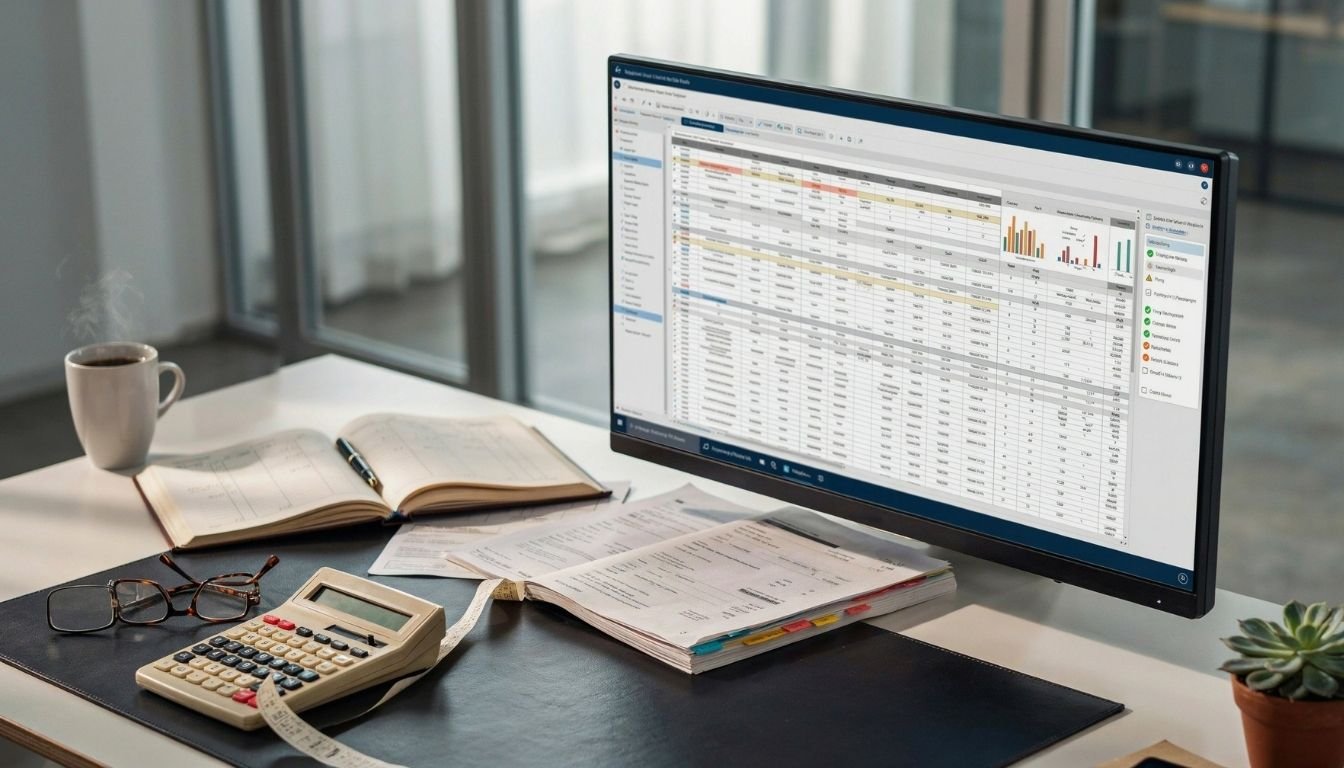
Company financial data validation and sourcing is the process of collecting financial information from credible sources and checking whether the information is accurate, complete, consistent and suitable for its intended use.
Businesses rely on financial data to evaluate profitability, monitor cash flow, compare performance, assess credit risk and make investment decisions. However, financial figures can become unreliable when records contain missing values, outdated information, inconsistent reporting periods or incorrect calculations.
Two activities work together to reduce these risks.
- Financial data sourcing identifies where each figure originated and whether the source is appropriate for the decision being made.
- Financial data validation checks whether the collected information follows defined rules and agrees with supporting records.
For example, an analyst evaluating a US manufacturing company might collect annual revenue from its financial statements, operating income from its income statement and outstanding debt from its balance sheet. Before calculating financial ratios, the analyst must confirm that the figures relate to the same reporting period and use compatible definitions.
A number can be mathematically correct but still be unsuitable for analysis if it comes from the wrong reporting period or represents a different financial measure.
Key Takeaways
- Reliable financial analysis starts with trustworthy data from identifiable sources.
- Validation checks financial figures for completeness, consistency, accuracy and logical errors.
- Original filings and audited statements provide stronger evidence than unsourced summaries.
- Reconciliation helps explain differences between accounting systems and external financial records.
- Documented validation rules and source histories make financial data easier to audit and maintain.
Where Should Company Financial Data Come From?
The right source depends on the company, the type of information required and the level of assurance needed.
Public companies generally provide more formal disclosure records than private businesses. Private company information may require a combination of internal accounting records, management reports, credit information and independently verified documents.
Primary sources for financial information
Regulatory filings
The SEC’s EDGAR system provides filings from public companies, including annual reports, quarterly reports and other disclosures. These records are useful for checking reported revenue, assets, liabilities, earnings and risk disclosures.
Audited financial statements
Audited statements can provide stronger assurance about financial reporting than unaudited internal summaries. Review the auditor’s opinion and any qualifications rather than assuming every audit provides an unmodified opinion.
Internal accounting records
General ledgers, trial balances, bank statements, accounts receivable records and accounts payable reports help validate financial totals against the company’s underlying transactions.
Financial data providers
Commercial databases can simplify company comparisons and historical analysis. Their figures should still be checked against original disclosures when accuracy, traceability or material financial decisions matter.
Secondary sources and supporting evidence
Additional sources can help verify or contextualize financial figures.
- Investor relations websites and annual report archives
- Bank confirmations and lender statements
- Contracts, invoices and transaction records
- State business records where relevant
- Credit reports and trade payment information
- Industry reports and economic datasets
Secondary sources are useful for research and cross-checking. They should not automatically override a more authoritative record simply because they are easier to access.
For US public companies, the original filing is usually the appropriate starting point for reported financial results. For a private company, access to original records may depend on authorization and the purpose of the review.
Which Financial Data Fields Need Validation?
Validation should cover more than whether a number looks reasonable. Each field needs checks that reflect its meaning, source and intended use.
| Data field | Validation checks | Common risk |
|---|---|---|
| Revenue | Reporting period, currency, revenue definition and supporting records | Mixing gross and net revenue |
| Net income | Expenses, taxes, gains and losses | Using earnings before tax as net income |
| Total assets | Balance sheet totals and accounting equation | Missing or duplicated asset balances |
| Total liabilities | Debt records, accrued expenses and current obligations | Omitting short-term liabilities |
| Cash balance | Bank reconciliation and statement date | Treating restricted cash as freely available |
| Outstanding debt | Loan statements, maturity dates and debt disclosures | Missing leases or debt due within one year |
| Cash flow | Operating, investing and financing classifications | Confusing cash flow with accounting profit |
| Financial ratios | Formula, units and compatible reporting periods | Comparing ratios calculated from different definitions |
These checks should be tailored to the data. A balance sheet validation rule will not necessarily work for a cash flow statement or a company’s operating metrics.
A Practical Process for Validating Company Financial Data
A repeatable process makes financial information easier to review, update and defend during an audit or business decision.
1. Define the purpose and scope
Decide whether the data supports investment research, lending, financial reporting, company benchmarking or internal management. Identify the companies, metrics, reporting periods and required level of assurance.
2. Collect and register the source records
Record the original document, company identifier, filing date, reporting period, currency and date the information was retrieved. Preserve the original file or a traceable reference.
3. Run automated validation checks
Test required fields, data types, duplicate records, numerical ranges, reporting dates and accounting relationships. Flag unusual results instead of silently changing them.
4. Reconcile important figures
Compare extracted values with the original statements and relevant supporting records. Investigate differences between databases, accounting systems and reporting periods.
5. Review exceptions and approve the data
Assign material discrepancies to a responsible reviewer. Record the explanation, correction, evidence and approval before releasing the dataset for analysis.
Build validation rules around actual accounting relationships
Basic automated checks can detect many errors before financial data reaches a dashboard or analysis model.
Useful rules include:
- Required company identifiers and reporting dates must be present.
- Monetary values must have a known currency and unit.
- Duplicate records must be identified before aggregation.
- Assets should equal liabilities plus shareholders’ equity, subject to consistent definitions and rounding.
- Beginning cash plus the net change in cash should reconcile to ending cash when the figures use the same scope and cash definition.
- Financial ratios must use the intended numerator and denominator.
- Prior-period changes beyond a defined threshold should trigger review.
For example, if total assets are reported as $12 million and total liabilities are $8 million, shareholders’ equity would generally be expected to equal $4 million under the standard balance sheet relationship.
A difference should trigger investigation. It should not automatically be treated as proof of fraud or a defective financial statement. Differences may result from rounding, classification, scope or extraction problems.
Automated validation confirms that data follows specified rules. It does not prove that the underlying transaction occurred or that the original figure is truthful.
How to Reconcile Financial Data From Different Sources
Two credible financial sources can report different values for the same company without either value necessarily being incorrect.
The reason may be a different reporting date, accounting definition, consolidation scope or data processing method.
Identify why the numbers differ
Suppose a financial database reports annual revenue of $500 million while a company’s annual report appears to show $480 million.
Before deciding which figure is correct, check the following:
- Reporting period: Do both figures cover the same fiscal year?
- Company scope: Does one include subsidiaries that the other excludes?
- Revenue definition: Is one value gross revenue and the other net revenue?
- Currency and units: Is one value reported in thousands while the other is in millions?
- Filing status: Was the original report amended or subsequently restated?
- Data extraction: Did the provider map the correct line item or use a different accounting tag?
If the annual report provides the correct consolidated revenue for the intended period, use that figure as the primary reference and document why the database differs.
Keep a reconciliation log
A reconciliation log prevents the same discrepancy from being investigated repeatedly.
| Field | Example entry |
|---|---|
| Company | Example Manufacturing Inc. |
| Metric | Annual revenue |
| Primary record | Annual financial statement |
| Primary value | $480 million |
| Secondary value | $500 million |
| Difference | $20 million |
| Investigation | Reporting scope and metric definition |
| Resolution | Pending confirmation |
| Reviewer | Assigned financial analyst |
The company and amounts in this example are illustrative.
Do not overwrite the original values before the discrepancy is resolved. Keeping both figures and the reason for the final decision creates a more reliable audit trail.
Common Errors That Reduce Financial Data Quality
Even established businesses can produce inconsistent datasets when collection and review processes are poorly controlled.
Mixing reporting periods
Annual revenue cannot be compared directly with quarterly revenue without adjusting the time frame. Balance sheet values also represent a specific date rather than activity over an entire period.
Ignoring amended financial statements
A company may file an amended report or restate previously reported figures. Historical datasets should retain filing dates and amendment status so analysts can identify which version they used.
Treating missing data as zero
A missing debt value does not prove that a company has no debt. It may indicate incomplete disclosure, an extraction problem or a field that does not apply.
Keep missing values distinct from confirmed zero values.
Overlooking custom financial tags
Public company filings use structured data formats such as Inline XBRL. Standard tags improve comparability, but companies may also use custom tags for information that does not fit an available standard concept.
Review the tag definition and the surrounding financial statement before mapping a custom tag to a standard metric. A similar label does not guarantee identical meaning.
Trusting automated checks without human review
Validation software can detect missing fields, invalid values and calculation inconsistencies. It cannot independently confirm every transaction or determine whether every accounting judgment is appropriate.
Use automated checks for repeatable controls and human review for unusual, material or ambiguous discrepancies.
Tools for Company Financial Data Validation and Sourcing
The appropriate tools depend on the size of the dataset, reporting requirements and the level of automation needed.
| Tool or approach | Best use | Main limitation |
|---|---|---|
| Microsoft Excel or Google Sheets | Small datasets, formula checks and manual reconciliation | Limited control over complex workflows without additional design |
| Accounting software | Transaction records, ledger balances and bank reconciliation | Depends on correct setup and complete source records |
| SQL databases | Duplicate detection, field validation and large structured datasets | Requires defined data models and validation logic |
| Python data-processing tools | Repeatable calculations, anomaly checks and file processing | Requires programming skills and testing |
| SEC EDGAR and its data APIs | Public company filings and structured financial facts | Does not cover every private company or guarantee extracted data is error-free |
| Commercial financial databases | Multi-company research and standardized metrics | Coverage, definitions, update frequency and licensing vary |
For US public company research, the SEC provides free access to regulatory filings and structured financial information. Its financial statement datasets are useful for analysis, but the SEC cautions that extracted datasets can contain errors and should not replace review of the original filings. SEC EDGAR is therefore a useful starting point rather than a substitute for validation.
When should a company automate validation?
Automation becomes more valuable when the same checks must run repeatedly across many companies or reporting periods.
Consider automation when:
- Analysts repeatedly collect the same financial metrics.
- Manual data entry creates frequent errors.
- Reports must be refreshed on a fixed schedule.
- Multiple systems need reconciliation.
- Financial discrepancies must be tracked and reviewed consistently.
A small business working with a limited number of records may only need a well-designed spreadsheet and documented review process. A financial research team maintaining thousands of company records may benefit from database controls, automated validation and exception reporting.
The goal is not to automate every task. It is to automate repeatable checks while preserving human oversight where judgment is required.
Expert Decision Guide for Choosing Reliable Financial Data
The best sourcing and validation approach depends on what the information will be used for and the consequences of getting it wrong.
Choose the source based on the decision
Public company research
Start with regulatory filings
Use annual and quarterly filings for reported results. Supplement them with structured datasets or commercial databases when comparing multiple companies. Verify important figures against the original disclosures.
Internal financial reporting
Start with accounting records
Reconcile the general ledger with bank statements, subsidiary records and supporting documents. Use approved accounting policies to resolve classification differences.
Credit or acquisition review
Require stronger supporting evidence
Combine available financial statements with debt records, cash evidence, material contracts and other relevant documentation. For high-value decisions, consider independent accounting or financial due diligence.
Large-scale benchmarking
Use standardized data with source traceability
A commercial database or structured filing feed can improve efficiency. Confirm metric definitions, reporting periods, company scope and historical changes before comparing results.
Evaluate data quality using five criteria
Before accepting a dataset, assess these five areas.
- Accuracy: Can important figures be traced to reliable records?
- Completeness: Are the required companies, periods and metrics present?
- Consistency: Do definitions, currencies and reporting periods align?
- Timeliness: Is the data current enough for the intended decision?
- Traceability: Can a reviewer reproduce the path from the original source to the final reported value?
A dataset can score well in four areas and still be unsuitable because of a serious weakness in the fifth. For example, current figures with no identifiable source may be inadequate for a lending decision or financial audit.
For higher-risk decisions, also assess access controls, change history, reviewer approval and the quality of supporting evidence.
Financial Data Quality Standards
| Control area | What good practice requires |
|---|---|
| Source documentation | Record the original document, filing date and retrieval date |
| Financial definitions | Define each metric and document calculation methods |
| Period alignment | Match fiscal periods and distinguish quarterly from annual figures |
| Reconciliation | Investigate material differences instead of forcing agreement |
| Exception handling | Record issues, explanations, corrections and approvals |
| Change management | Preserve historical versions and track amendments |
| Access control | Limit unauthorized changes to financial records |
| Review frequency | Refresh data according to reporting schedules and decision needs |
These are recommended operational controls rather than a single mandatory standard that applies to every organization. Specific legal, regulatory and audit requirements depend on the business and its circumstances.
FAQs
What is company financial data validation and sourcing?
Company financial data validation and sourcing combines the collection of financial information from credible records with checks for completeness, consistency, accuracy and traceability. It helps analysts and businesses identify unreliable figures before using them in reports or financial decisions.
What is the most reliable source of company financial data?
For US public companies, original SEC filings are a strong starting point for reported financial information. For private companies, reliability depends on access to original accounting records, supporting documents and appropriately reviewed financial statements.
How can financial data accuracy be checked?
Check source documents, reporting dates, currencies, units, accounting relationships and supporting transactions. Reconcile important values across relevant systems and investigate discrepancies before approving the data.
Why can two financial databases show different company figures?
Differences may result from reporting periods, consolidation scope, accounting definitions, currency conversions, amended filings or data extraction errors. Compare the underlying definitions and original records before deciding which figure is appropriate.
Can financial data validation be fully automated?
No. Automated tools can perform repeatable checks and flag anomalies, but they cannot establish the factual truth of every financial record. Human review remains important for material discrepancies, unusual transactions and complex accounting judgments.
How often should company financial data be validated?
Validate data when it is collected or updated and before it is used for a material decision. Internal financial records may require daily or monthly controls, while public company datasets should be refreshed according to filing schedules and research requirements.
What is the difference between financial data validation and reconciliation?
Validation checks whether data meets defined requirements such as correct formats, complete fields and accounting relationships. Reconciliation compares related records or balances to identify and explain differences between sources.
How can a company improve financial data traceability?
Assign each important metric a source reference, reporting period, definition and retrieval date. Preserve original records, document transformations, record corrections and maintain an approval history so another reviewer can reproduce the result.