
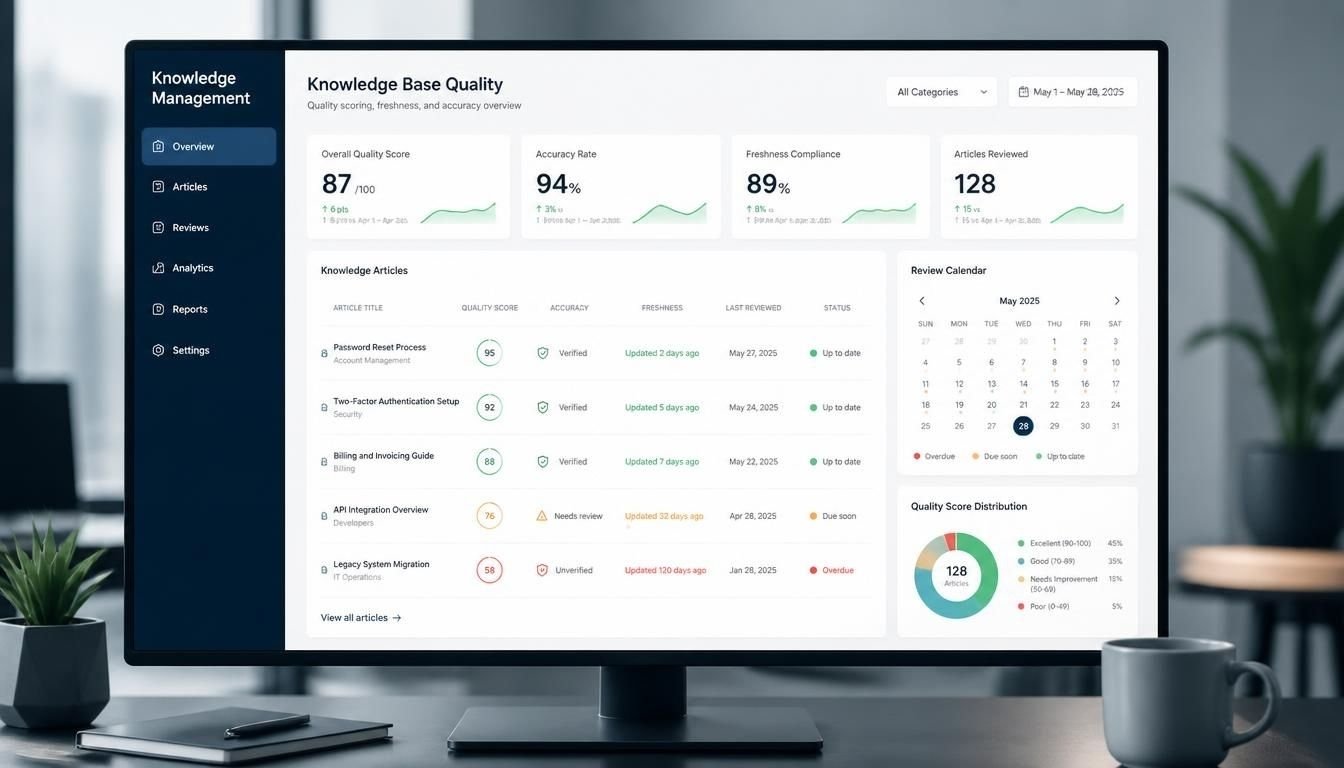
A reliable knowledge base needs more than well-written articles. Its information must be correct, current, complete and easy to use. Knowledge base quality scoring metrics freshness accuracy help support teams identify outdated instructions, correct factual errors and decide which articles need attention first.
A practical scoring system turns these requirements into measurable criteria. Instead of reviewing every article with the same level of urgency, teams can prioritize information that affects customers, employees, business operations or compliance.
What Should a Knowledge Base Quality Score Measure?
A knowledge base quality score is a numerical assessment of how well an article meets defined content standards. It can combine several quality dimensions into one score while keeping individual measurements visible.
The most useful dimensions measure different problems rather than counting the same weakness multiple times.
| Quality metric | What it measures | Example of a problem |
|---|---|---|
| Accuracy | Whether claims and instructions are correct | An article describes an outdated product feature |
| Freshness | Whether information reflects current conditions | A support article contains last year’s pricing |
| Completeness | Whether readers have enough information to finish a task | Instructions skip an important setup step |
| Clarity | Whether users can understand the content | A technical explanation uses unexplained terminology |
| Consistency | Whether related articles agree with each other | Two pages give different refund instructions |
| Usability | Whether readers can find and apply the information | The correct answer is buried in a long article |
| Source reliability | Whether claims can be verified against approved information | A policy statement has no identifiable owner or approved reference |
Accuracy and freshness should remain separate. An article can be factually correct but too old to reflect a recent policy change. It can also have a recent review date while containing an incorrect answer.
How to Measure Knowledge Base Accuracy
Accuracy measures whether the information in an article matches verified facts, approved policies and current product behavior.
It should receive particular attention when content explains billing, account security, technical troubleshooting, warranties or other decisions where an incorrect answer could cause harm or financial loss.
Use a Repeatable Accuracy Checklist
Review each article against specific questions.
- Are all factual statements correct?
- Do instructions work in the current product or process?
- Are prices, limits, requirements and eligibility rules accurate?
- Do links lead to the intended resources?
- Does the article match the latest approved policy?
- Are warnings and exceptions included where necessary?
- Can the reviewer verify important claims against an authoritative internal source?
A reviewer should record the number of checks passed and failed. However, a simple pass rate should not be the only measure because some errors are much more serious than others.
For example, an incorrect comma has little effect on a troubleshooting article. An incorrect instruction that causes users to lose data deserves immediate attention.
Calculate an Accuracy Score
One basic method is to divide the number of correctly verified checks by the total number of checks.
\[ \text{Accuracy Score}= \frac{\text{Checks Passed}}{\text{Total Checks}}\times100 \]
Suppose an article has 20 verification checks and 18 pass.
\[ \frac{18}{20}\times100=90\% \]
The article receives an accuracy score of 90%. The two failed checks should still be reviewed individually to determine their severity.
For high-risk information, one critical error may require the article to be corrected or temporarily withdrawn even if its overall score is high.
How to Measure Knowledge Base Freshness
Freshness measures whether an article has been reviewed and remains relevant to the current product, policy or process.
A recent publication date does not automatically mean an article is current. Similarly, an older article may remain completely accurate if it describes a stable process.
Track More Than the Last Updated Date
A useful freshness assessment includes:
- Last substantive review date
- Scheduled review date
- Number of days since the last review
- Date of the latest relevant product or policy change
- Whether the content owner has verified the information
- Whether users have reported outdated instructions
A substantive review means someone checked the information. Changing formatting or correcting a typo should not automatically reset the freshness clock.
Set Review Intervals According to Risk
Different types of content become outdated at different speeds. The following intervals are starting recommendations rather than universal standards.
| Content type | Suggested review interval | Why it matters |
|---|---|---|
| Security and emergency procedures | After relevant changes and at least quarterly | Incorrect instructions may create serious risks |
| Pricing and billing policies | Monthly or after a policy change | Financial information can change quickly |
| Product troubleshooting | Quarterly or after major releases | Software behavior and interfaces change |
| Employee procedures | Every 6–12 months or after process changes | Internal workflows may evolve |
| General educational content | Every 12 months or when facts change | Stable concepts may need less frequent review |
The appropriate interval depends on the rate of change, consequences of errors and business requirements. Regulatory or contractual obligations may require more frequent reviews.
Calculate a Freshness Score
A simple age-based model can help identify articles that need review.
\[ \text{Freshness Score}= \max\left(0,100\times\left(1-\frac{D}{I}\right)\right) \]
Where:
- \(D\) is the number of days since the last substantive review.
- \(I\) is the target review interval in days.
For example, an article last reviewed 30 days ago with a 90-day review interval receives a freshness score of approximately 66.7.
This model is easy to automate, but it measures review age rather than factual correctness. A newly reviewed article can still be wrong. Freshness scores should therefore trigger checks, not replace them.
How to Build a Weighted Knowledge Base Quality Score
Once individual metrics are defined, teams can combine them into a single quality score. The weights should reflect the organization’s goals and the consequences of poor information.
A general-purpose customer support knowledge base could start with the following model.
| Quality dimension | Suggested weight |
|---|---|
| Accuracy | 35% |
| Freshness | 25% |
| Completeness | 15% |
| Clarity | 10% |
| Consistency | 10% |
| Usability | 5% |
| Total | 100% |
These percentages are an illustrative framework, not an industry-wide standard. A medical, financial or compliance knowledge base may need stronger accuracy controls and separate mandatory approval rules.
Calculate the weighted score by multiplying each metric score by its assigned weight and adding the results.
\[ Q=\sum_{i=1}^{n}\frac{S_iW_i}{100} \]
Here \(S_i\) is an individual metric score and \(W_i\) is its percentage weight.
Example of a Weighted Quality Score
Consider a support article with these assessment results.
| Metric | Score | Weight | Weighted contribution |
|---|---|---|---|
| Accuracy | 90 | 35% | 31.50 |
| Freshness | 70 | 25% | 17.50 |
| Completeness | 85 | 15% | 12.75 |
| Clarity | 90 | 10% | 9.00 |
| Consistency | 80 | 10% | 8.00 |
| Usability | 95 | 5% | 4.75 |
| Total quality score | 100% | 83.50 |
The resulting quality score is 83.5 out of 100.
The article performs well overall, but freshness is its weakest dimension. The team should check whether its information is still current before deciding that no changes are needed.
Define Score Bands That Lead to Action
A score becomes more useful when it leads to a clear next step.
| Score range | Suggested status | Recommended action |
|---|---|---|
| 90–100 | Strong | Maintain and monitor |
| 80–89 | Acceptable | Review weaker metrics |
| 65–79 | Needs improvement | Schedule a targeted update |
| Below 65 | Poor | Prioritize a full review |
These bands are proposed starting points. Teams should validate them against actual content errors, customer feedback and support outcomes.
A high average must never override a critical failure. If an article contains a dangerous instruction or a materially incorrect billing policy, it needs immediate review regardless of its overall score.
Which Knowledge Base Quality Metrics Should You Track Alongside the Score?
A quality score describes content standards, but it does not prove that users are getting the help they need. Operational metrics provide that missing context.
Failed Searches and Content Gaps
Track searches that return no useful results, repeated searches using different wording and common questions that have no matching article.
These signals can reveal missing content or problems with article titles, tags and search indexing.
Article Feedback
Collect positive and negative feedback, but review the comments rather than relying only on the rating.
A negative rating may indicate incorrect information, unclear writing, an incomplete answer or a problem with the underlying product.
Repeat Support Contacts
Measure how often users contact support again after viewing an article or following its instructions.
Repeat contacts can indicate that the content did not solve the problem. However, some issues naturally require human assistance, so this metric should be interpreted by topic and case type.
Self-Service Resolution
Estimate how often users resolve an issue without opening a support ticket or contacting an agent.
A useful measurement might compare eligible support sessions that end without further assistance against all eligible support sessions. The team must define the measurement window and account for users who abandon the process without resolving their issue.
Article Usage
Track views, search impressions, helpfulness ratings and engagement over time.
High traffic does not necessarily mean high quality. A frequently viewed article may attract users because it is essential, difficult to understand or the only available resource for a common problem.
How to Prioritize Articles That Need Updating
A knowledge base with thousands of articles cannot always be reviewed manually at the same time. Prioritization should combine quality scores with business impact and the likelihood of an error.
A practical workflow has four steps.
- Identify critical failures. Flag incorrect instructions, policy conflicts, security concerns and other high-impact problems for immediate review.
- Find weak scores. Filter articles with low accuracy, freshness or completeness scores.
- Check usage and feedback. Give additional attention to articles used frequently or associated with repeated support contacts.
- Assign ownership and deadlines. Give each flagged article an accountable owner, a review deadline and a recorded resolution.
For example, an outdated password-reset article may affect many users, while an outdated description of a rarely used feature may have limited impact. The first article should usually receive higher priority, provided both issues have been assessed for severity.
Do not rely on the overall score alone. A separate critical-error flag and an impact rating can prevent urgent problems from being hidden by strong results in other categories.
How to Automate Freshness and Accuracy Checks
Automation can reduce manual effort, but it cannot reliably judge every factual statement without appropriate reference information.
Automate Freshness Monitoring
A content management system or simple spreadsheet can store:
- Article ID and title
- Content owner
- Last substantive review date
- Next review date
- Review interval
- Current quality score
- Open issues and status
A scheduled workflow can flag overdue reviews and send reminders to owners. Event-based triggers should also initiate reviews after relevant product releases, policy revisions or process changes.
Use Automated Checks for Clear Rules
Automated tools can identify:
- Broken links
- Missing owners or review dates
- Expired announcements
- Outdated product names
- Conflicting versions of approved text
- Articles below a defined score threshold
These checks work best when the rules are explicit and the relevant reference data is available.
Keep Human Review for Meaning and Accuracy
A human reviewer should verify whether instructions still work, whether exceptions are explained and whether the content matches the approved policy.
AI can help compare documents, identify inconsistencies and flag statements for review. However, an AI-generated quality score should not be treated as proof that the article is factually correct.
Use automated checks to identify likely problems and qualified reviewers to confirm them.
Expert Decision Framework for Choosing a Quality Scoring Model
The best model depends on the size of the knowledge base, the risk of incorrect information and the resources available for ongoing maintenance.
Choose a Simple Checklist for a Small Knowledge Base
A checklist is often sufficient when a team maintains a limited number of articles.
Use a consistent set of questions, record pass or fail results and assign a reviewer. This approach is easy to introduce and helps establish quality standards before adding more complex scoring.
Choose Weighted Scoring for a Larger Knowledge Base
A weighted model is more useful when teams need to compare hundreds or thousands of articles.
It helps identify weak areas across a collection and gives content managers a consistent way to allocate review resources. Individual metric scores should remain visible so teams can understand why an article received its overall score.
Choose Risk-Based Scoring for High-Impact Content
For content involving financial decisions, security, compliance or safety, use weighted scores alongside mandatory controls.
For example, an article may receive a high general quality score but fail a required legal review. It should remain flagged until the mandatory requirement is met.
Compare the Options Before Implementing One
| Approach | Best use | Main advantage | Main limitation |
|---|---|---|---|
| Manual checklist | Small collections | Easy to understand | Requires reviewer time |
| Weighted quality score | Large content libraries | Supports comparison and prioritization | Weights can hide critical failures |
| Automated rules | Routine maintenance | Detects predictable problems at scale | Cannot verify every meaning or fact |
| Risk-based model | High-impact information | Prioritizes consequences of errors | Requires clear risk definitions |
For most support teams, a practical starting point is a weighted score combined with automated freshness alerts and mandatory human review for critical content. This offers useful prioritization without creating an unnecessarily complex system.
FAQs
What are the most important knowledge base quality scoring metrics freshness accuracy?
Accuracy and freshness are essential because users need information that is both correct and current. Completeness, clarity, consistency and usability provide additional measures of whether an article can solve the user’s problem.
What is a good knowledge base quality score?
A score of 90 or higher can be a useful internal target for well-maintained content. However, there is no universal benchmark. Teams should validate their score bands against real errors, user outcomes and the risk associated with each article.
How often should knowledge base articles be reviewed?
Review intervals should reflect how quickly the information changes. Pricing and security instructions may need frequent checks, while stable educational content may only need an annual review. Important product or policy changes should trigger an earlier review.
Can AI measure knowledge base accuracy?
AI can compare content against approved references, identify inconsistencies and flag suspicious claims. Human verification is still important because an automated system can misunderstand context or accept an incorrect reference as true.
How do you calculate a knowledge base freshness score?
A basic method compares the number of days since the last substantive review with the target review interval. This produces an age-based score, but teams should separately verify whether the article’s information remains correct.
Should freshness and accuracy have equal weights?
Not necessarily. The weights should reflect the content’s purpose and risk. For a rapidly changing product, freshness may deserve more weight. For technical, financial or safety-related instructions, accuracy may need stronger controls.
What is the difference between a content quality score and a self-service score?
A content quality score measures how well an article meets defined standards. A self-service score estimates whether users can resolve issues without contacting support. Both are useful because an accurate article may still be difficult to find or apply.
How can teams prevent outdated knowledge base articles?
Assign every important article an owner, set review deadlines, automate reminders and trigger reviews after relevant changes. Track overdue articles and archive content that is no longer needed rather than allowing obsolete instructions to remain available.
Use Quality Scores to Guide the Next Review
Knowledge base quality scoring works best when every score leads to a practical action. Measure accuracy against verified information, assess freshness according to the content’s rate of change and use completeness and usability scores to identify other weaknesses.
Start with a small set of measurable criteria and clear ownership. Add automation where rules are predictable, retain human review where judgment matters and use user feedback to validate whether updates actually improve support outcomes.
The goal is not to achieve a perfect number on a dashboard. It is to make sure users can trust the information they find and act on it with confidence.