
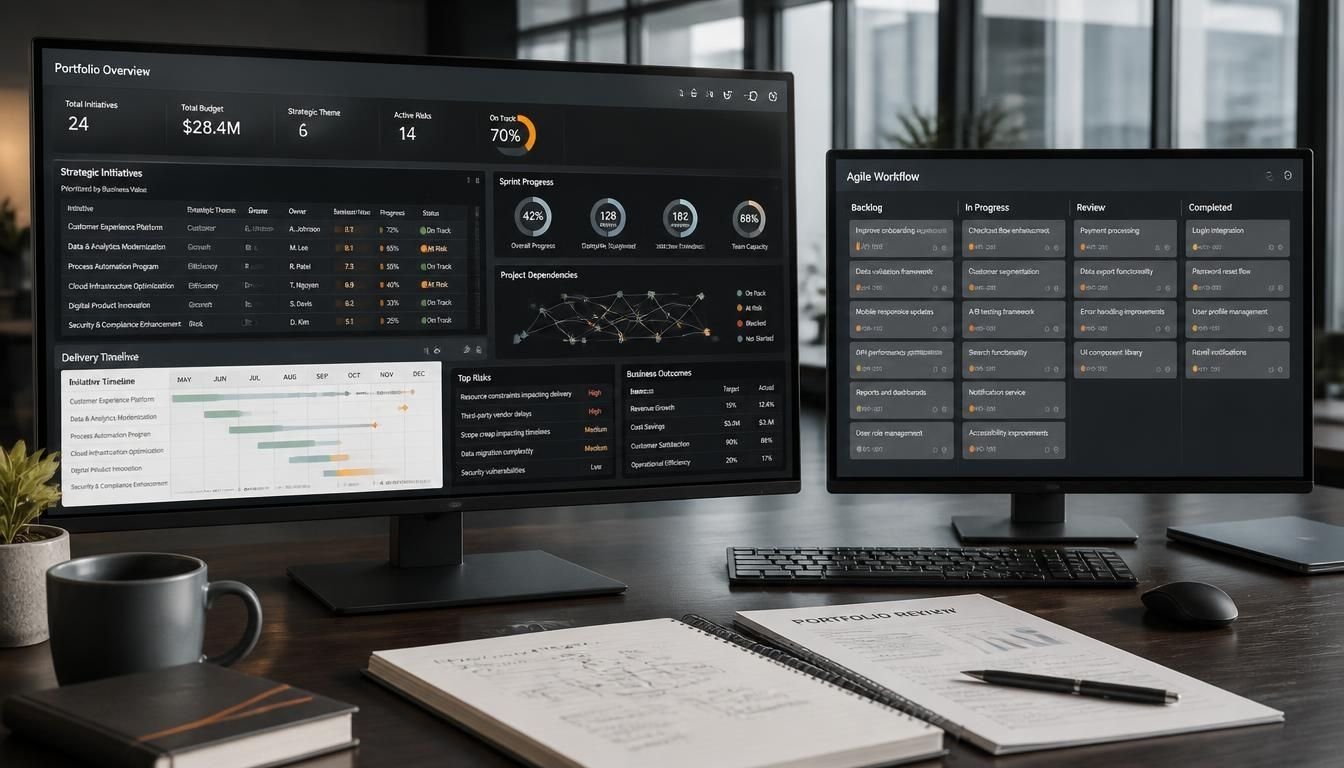
An agile project management office is a PMO that supports adaptive planning, continuous delivery, cross-team coordination, and value-based decision-making. Instead of relying primarily on fixed project plans and extensive reporting, it helps teams respond to change while maintaining appropriate oversight.
Its purpose is not to eliminate project management. It is to make project management more responsive to business needs.
For example, a US software company may have several teams developing customer features, maintaining infrastructure, and improving security. Each team needs flexibility to manage its work, but company leadership still needs to understand delivery progress, spending, risks, and competing priorities.
An Agile PMO connects these two needs. It establishes shared expectations, helps teams resolve dependencies, and gives decision-makers enough information to direct investment without controlling every development task.
- An Agile PMO connects business priorities with teams that deliver work in short, measurable cycles.
- Its role is to enable teams, remove organizational barriers, and provide useful delivery information rather than enforce unnecessary processes.
- Agile governance maintains accountability for budgets, risks, dependencies, and business outcomes without requiring approval for every small decision.
- Portfolio prioritization helps organizations avoid spreading people across too many active projects.
- A successful transition starts with a specific business problem, a small pilot, and measurable results.
How an Agile PMO Differs From a Traditional PMO
A traditional PMO often emphasizes standard methods, project plans, reporting, and compliance with established procedures. An Agile PMO can retain these responsibilities while changing how they are applied.
The distinction is not simply that one uses Agile and the other does not. Traditional PMOs can support Agile teams, and Agile PMOs still need governance. The difference lies in how decisions are made, how progress is measured, and how much authority teams have to manage their work.
| Area | Traditional PMO approach | Agile PMO approach |
|---|---|---|
| Planning | Emphasis on detailed plans and baseline control | Rolling plans updated as priorities and information change |
| Progress tracking | Milestones, schedules, and completion reports | Incremental delivery, outcomes, risks, and flow of work |
| Governance | Formal checkpoints and approval procedures | Oversight scaled to risk, investment, and business impact |
| Change management | Changes may require formal change requests | Teams adapt within agreed priorities and decision boundaries |
| Resource allocation | Resources assigned across approved projects | Capacity aligned with prioritized work and stable teams |
| Reporting | Standardized status reports | Timely information that supports decisions |
| Team support | Methodology compliance and project oversight | Coaching, dependency resolution, and continuous improvement |
These approaches are not mutually exclusive. A company managing construction, financial compliance, and software development may need different controls for each type of work.
The goal is to apply the level of planning and oversight appropriate to the work rather than force every team into one delivery model.
What Does an Agile PMO Actually Do?
The office creates the conditions for teams to deliver valuable work while helping leadership coordinate decisions across the organization.
1. Connects Business Strategy With Delivery Priorities
An organization can have more valuable ideas than its teams have time to implement. Without a clear prioritization process, departments may start too many initiatives and distribute employees across competing deadlines.
An Agile PMO helps leaders maintain a shared view of proposed, active, and completed initiatives.
It can support decisions based on:
- Strategic alignment and expected business value.
- Customer needs and time-sensitive opportunities.
- Regulatory obligations and operational risks.
- Dependencies between teams and projects.
- Available skills, funding, and delivery capacity.
For example, a financial services company may need to improve its customer portal, replace an internal reporting system, and address a security requirement.
The PMO helps decision-makers understand the trade-offs and sequence the work. It does not automatically assign equal priority to all three initiatives or allow every department to declare its own project urgent.
2. Establishes Agile Governance Without Unnecessary Delays
Agile delivery does not remove accountability for money, security, legal obligations, or business risk.
The PMO defines the decisions teams can make independently and the situations that require additional approval.
A development team might be free to adjust the order of backlog items within an approved product objective. A change that affects a regulatory deadline, approved budget, or another team’s release may require a wider decision.
This approach prevents two common problems. Teams do not need executive approval for every routine adjustment, but significant decisions remain visible to the people responsible for their consequences.
3. Improves Visibility Across Teams
Individual teams can understand their own work while leadership remains unaware of broader delivery problems.
An Agile PMO provides a shared view of important information such as:
- Work currently in progress.
- Major dependencies and unresolved blockers.
- Expected delivery dates and changes to forecasts.
- Budget use and remaining funding.
- Risks requiring leadership decisions.
- Outcomes already delivered and still expected.
The information should help people take action. A dashboard that shows dozens of status indicators but does not reveal the decision required is unlikely to improve delivery.
4. Supports Agile Capability and Continuous Improvement
Teams may understand Scrum or Kanban but still struggle with prioritization, estimation, stakeholder collaboration, or managing dependencies.
The PMO can provide coaching, reusable templates, training, and opportunities for teams to share what works.
It should also identify recurring organizational problems. If several teams wait days for the same approval, the issue may be an outdated decision process rather than poor team performance.
The PMO can work with the responsible leaders to change that process and then check whether delivery has improved.
Which Metrics Should an Agile PMO Track?
The right metrics depend on the organization’s goals, delivery methods, and risks. Measuring every available indicator creates reporting work without necessarily improving decisions.
A useful measurement system connects delivery activity to business outcomes.
| Metric | What it tells you | Important limitation |
|---|---|---|
| Lead time | How long work takes from a defined starting point to completion | The start and end points must be consistent |
| Cycle time | How long an item takes once work begins | Complex items may not be directly comparable |
| Throughput | Number of work items completed during a period | More completed items do not automatically mean more value |
| Work in progress | How much work remains unfinished | A low number alone does not prove healthy delivery |
| Forecast accuracy | How closely forecasts match actual delivery | Estimates should not become artificial performance targets |
| Defect and rework rates | Quality problems and repeated effort | Metrics need context about product complexity |
| Business outcomes | Whether delivered work achieves its intended result | Outcomes may take time to become measurable |
| Budget variance | Difference between planned and actual spending | Spending must be considered alongside scope and value |
Why output metrics are not enough
A team might complete 40 small tasks in a month while another completes 12 larger tasks. Comparing those numbers alone says little about productivity because the work may differ in complexity, risk, and business impact.
Similarly, completing a project on schedule does not prove that the project achieved its intended purpose.
An Agile PMO should combine delivery measures with outcome measures. For a customer portal, this might mean tracking release frequency alongside successful task completion, customer support issues, or another relevant business objective.
Metrics should support learning and decisions, not encourage teams to manipulate numbers to meet arbitrary targets.
How to Implement an Agile PMO
An organization does not need to redesign every project process at once. A phased approach makes it easier to test assumptions, gather feedback, and adjust the operating model before expanding it.
Step 1. Identify the Problems the PMO Must Solve
Start by examining current delivery issues.
Are projects delayed because teams depend on one another? Are priorities constantly changing? Does leadership receive inconsistent status reports? Are employees assigned to too many initiatives at once?
Identify the problems that create the greatest business impact.
The PMO’s initial responsibilities should address those problems rather than introduce a large collection of Agile ceremonies, templates, and dashboards.
Step 2. Define Decision Rights
Clarify who owns product priorities, delivery commitments, budget decisions, risk acceptance, and cross-team dependencies.
For example, a product owner may control backlog priorities within an approved objective, while an executive sponsor approves a material increase in funding.
The exact division of authority will vary by organization. What matters is that employees know which decisions they can make and when they need support.
Step 3. Pilot the Operating Model
Choose a project or group of teams that can test the proposed changes.
The pilot should have a clear business objective, a known problem, and stakeholders willing to participate.
A practical pilot might introduce a shared portfolio backlog, a lightweight risk review, and a consistent approach to reporting delivery progress.
Keep the scope limited enough that the organization can identify what helped, what created extra work, and what needs to change.
Step 4. Establish a Useful Reporting Rhythm
Decide which information teams and executives need and how frequently they need it.
Teams may review blockers regularly, while portfolio leaders may review priorities, funding, and cross-team dependencies on a different schedule.
The purpose is to make decisions at the right time. A recurring meeting should have a clear reason to exist, and routine status updates should not require lengthy manual reports if reliable information is already available.
Step 5. Review Results Before Expanding
Compare the pilot with its starting conditions.
Look for changes in delivery delays, unresolved dependencies, reporting effort, work in progress, and progress toward the intended business outcome.
Not every improvement will be attributable to the PMO alone. Record other relevant changes and avoid claiming success based on a single metric.
Use the findings to refine the model before introducing it to more teams.
Common Mistakes That Undermine an Agile PMO
Keeping every traditional approval process
Adding Agile ceremonies to an unchanged approval system can increase administrative work without improving responsiveness.
Review which approvals protect against real financial, operational, security, or compliance risks. Simplify procedures that exist mainly because they have always been part of the process.
Measuring activity instead of outcomes
The number of meetings, completed tasks, or submitted reports does not establish whether the organization is delivering useful results.
Use measures that connect work to customer needs, operational improvements, risk reduction, or other agreed business objectives.
Centralizing decisions that teams can make themselves
If every priority adjustment or routine technical decision requires PMO approval, teams lose the ability to respond quickly.
Set clear boundaries and allow teams to act within them. Escalate decisions when they affect broader priorities, material risks, budgets, or commitments.
Applying one Agile framework to every department
Software development, infrastructure, compliance, and physical operations do not always work in the same way.
The PMO can establish common principles for transparency, prioritization, and accountability while allowing different teams to use Scrum, Kanban, hybrid approaches, or more formal project controls where appropriate.
Expanding before the pilot demonstrates value
A new structure can look successful because it creates more meetings and documentation. Those activities do not establish that delivery has improved.
Expand only after the pilot provides credible evidence that the operating model solves the original problems without introducing disproportionate overhead.
Decision-Making Help: Does Your Organization Need an Agile PMO?
An Agile PMO is most relevant when an organization needs better coordination across teams without sacrificing their ability to adapt.
It may be worth considering if leadership struggles to prioritize competing initiatives, teams repeatedly wait on cross-functional decisions, project reports do not reflect delivery reality, or the organization cannot connect investment to measurable outcomes.
A full PMO transformation may not be necessary if one team is simply struggling with sprint planning or unclear task ownership. Those problems may be better addressed through team coaching and improved working agreements.
Likewise, an organization with substantial regulatory obligations should not remove controls simply to appear more Agile. It should identify which controls are essential, which decisions can be delegated, and how evidence of compliance can be maintained with less unnecessary effort.
Before making a structural change, answer three questions.
- What business problem will the PMO solve? Identify a specific delivery, prioritization, governance, or coordination problem.
- What authority will it have? Decide whether it will advise teams, coordinate portfolios, establish standards, or make defined investment decisions.
- How will its contribution be measured? Select a small set of indicators linked to the original problem and review them after implementation.
If these questions have clear answers, the organization can design a PMO around actual needs rather than copying another company’s structure.
Frequently Asked Questions
What is an agile project management office?
An agile project management office is a function that helps an organization coordinate priorities, support adaptive delivery, maintain appropriate governance, and measure business outcomes. It gives teams guidance and organizational support while allowing them to manage work within agreed boundaries.
What is the difference between an Agile PMO and a traditional PMO?
A traditional PMO often emphasizes standardized processes, project plans, reporting, and controls. An Agile PMO retains necessary oversight but places greater emphasis on adaptive planning, incremental delivery, team autonomy, and continuous improvement. Actual responsibilities depend on the organization.
Can an Agile PMO work with Scrum and Kanban?
Yes. It can support Scrum teams using backlogs, sprint planning, and reviews, as well as Kanban teams managing continuous work through workflow stages. The PMO should help coordinate priorities and dependencies without forcing every team to use the same framework.
Who leads an Agile PMO?
Leadership may sit with a PMO director, an Agile transformation leader, or another experienced portfolio or delivery leader. The position requires an understanding of governance, business priorities, team workflows, organizational change, and outcome measurement. The reporting structure depends on the organization’s size and responsibilities.
How do you measure the success of an Agile PMO?
Measure whether it improves the problems it was created to solve. Relevant indicators may include delivery lead time, unresolved dependencies, forecast accuracy, reporting effort, budget performance, and progress toward business objectives. No single metric provides a complete picture.
Does an Agile PMO eliminate project managers?
No. It changes how project management responsibilities are organized rather than automatically removing them. Project managers may continue to coordinate dependencies, manage risks, support stakeholders, and maintain delivery visibility. Responsibilities can shift as teams become more autonomous.
How long does it take to establish an Agile PMO?
The timeline depends on organizational size, existing governance, team maturity, and the scope of the change. A limited pilot can test specific practices over several weeks, while broader organizational changes may require months or longer. These are planning ranges, not guaranteed implementation timelines.
What is the biggest challenge when moving to an Agile PMO?
The main challenge is changing decision-making and organizational behavior, not simply introducing Agile tools. If leadership continues to demand fixed commitments regardless of new information, or if teams lack authority to respond to change, new ceremonies and dashboards will not resolve the underlying problem.
An effective Agile PMO connects strategy, governance, and delivery without creating unnecessary barriers. Its value comes from helping the organization make better decisions, resolve constraints, and deliver work that achieves meaningful business outcomes.