
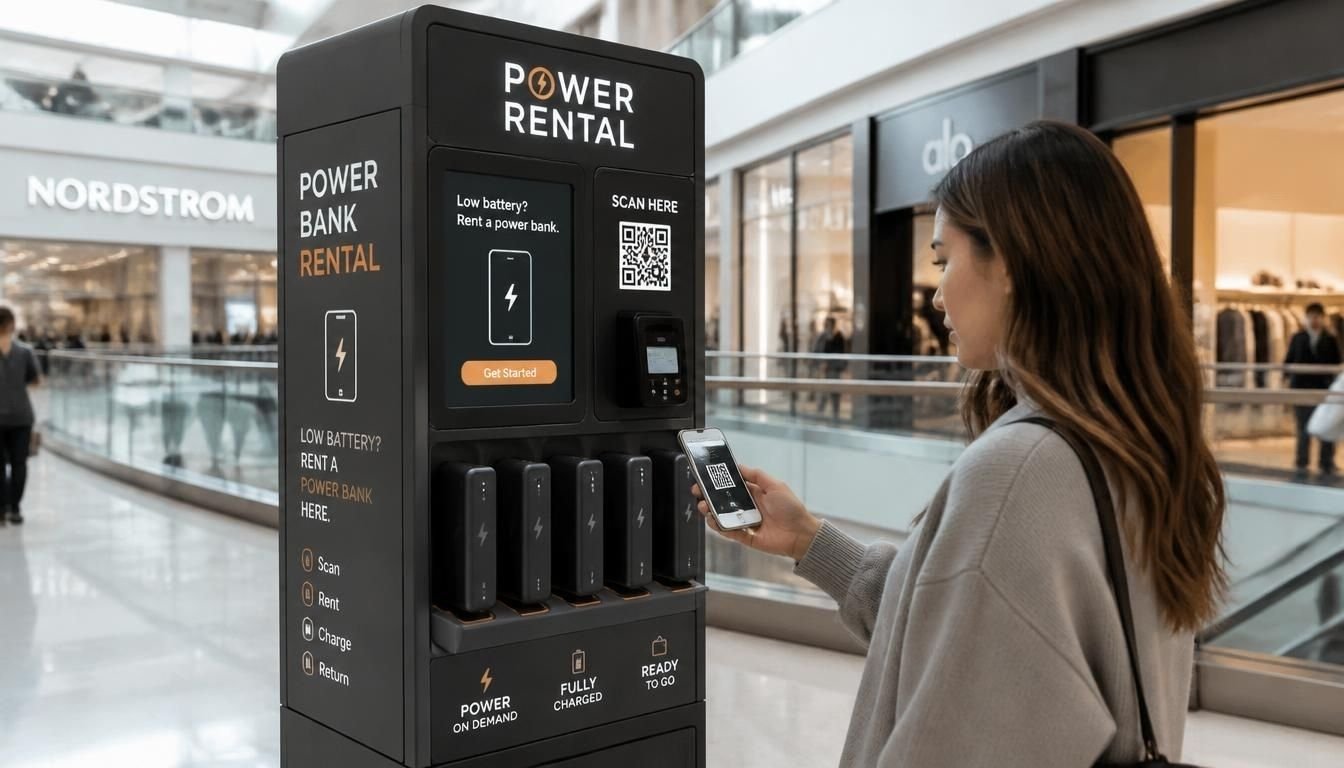
The business model for power bank rental kiosk operations industry report examines how businesses generate revenue by providing portable charging solutions through self-service kiosks. The model connects customers who need temporary phone charging with restaurants, hotels, shopping centers, entertainment venues and other businesses that can host rental stations.
Unlike traditional phone charging stations where customers remain near an electrical outlet, power bank rental kiosks allow customers to borrow a portable battery and carry it while using their phones. Customers typically scan a QR code, complete a payment, unlock a power bank and return it to a compatible station after use.
For operators, the opportunity involves more than purchasing charging equipment. They must establish profitable venue partnerships, select suitable locations, manage rental transactions, maintain battery availability and monitor financial performance.
The business can operate through independently owned kiosks, distributor agreements or fully managed venue partnerships. Each structure has different investment requirements, responsibilities and revenue opportunities.
How the Power Bank Rental Kiosk Business Model Works
The business operates through a technology-enabled rental system that connects physical charging stations with payment processing and inventory management software.
A typical rental transaction follows five steps.
- Customer discovery: A visitor notices a charging kiosk inside a participating business or public venue.
- Rental initiation: The customer scans the kiosk QR code or uses an available card payment option.
- Payment authorization: The platform processes the rental and activates the selected power bank compartment.
- Battery usage: The customer takes the portable charger and uses it while moving around.
- Battery return: The customer returns the power bank to a compatible station within the network.
The software records the transaction and updates the available battery inventory.
Depending on the network, customers may return the power bank to the original kiosk or another compatible station. This distinction is important because a larger return network can make the service more convenient and encourage additional rentals.
Main Participants in the Business Model
The business involves several participants with different responsibilities.
| Participant | Main responsibility | Commercial benefit |
|---|---|---|
| Kiosk operator | Equipment investment and operations | Rental and advertising income |
| Venue partner | Provides physical space and customer access | Revenue share or customer amenity |
| Technology provider | Software and network infrastructure | Platform or service fees |
| Payment provider | Processes customer transactions | Transaction processing fees |
| Customer | Rents and returns power banks | Convenient portable charging |
The exact arrangement depends on the partnership agreement. Some operators own the equipment and manage everything locally, while others rely on a technology provider for software, maintenance and network support.
Three Main Business Models for Power Bank Rental Operations
Choosing the operating structure is one of the most important decisions when entering this industry.
The three common approaches differ in capital requirements, operational responsibilities and control over revenue.
1. Independent Kiosk Ownership Model
Under this structure, the business purchases charging kiosks and portable power banks directly from equipment manufacturers or distributors.
The operator controls the deployment strategy and manages the commercial relationships.
Typical responsibilities include:
- Purchasing charging stations and compatible batteries.
- Selecting target cities and commercial locations.
- Negotiating agreements with venue owners.
- Setting rental prices where the network allows it.
- Managing payments and customer transactions.
- Monitoring equipment performance.
- Replacing damaged or missing batteries.
- Handling maintenance and customer support.
Revenue potential: The operator retains the largest possible share of rental revenue because it controls the equipment and venue relationships.
However, the operator also carries greater financial risk. Equipment purchases, software subscriptions, payment fees and field operations can reduce profitability.
This model is suitable for entrepreneurs who want control over their business and have enough capital to establish and maintain a local network.
2. Distributor or Technology Partnership Model
In this model, an operator partners with an established power bank rental platform.
The technology provider supplies some combination of hardware, software, payment infrastructure, customer-facing applications and network connectivity.
The local distributor focuses on market development and physical operations.
Common responsibilities include:
- Finding suitable commercial venues.
- Establishing local business partnerships.
- Installing and activating kiosks.
- Maintaining equipment.
- Monitoring rental activity.
- Managing local customer relationships.
Revenue is distributed according to the platform agreement.
For example, some distributor programs advertise an 80% operator share of rental revenue, while other arrangements offer different percentages depending on equipment ownership and services provided. These are individual commercial terms rather than universal industry rates. JB Charging+1
Revenue potential: This structure can reduce the technical burden and provide access to an established rental network.
The main disadvantage is dependence on the technology provider. Operators may have limited control over pricing, transaction fees, customer data, territory restrictions and platform changes.
3. Venue Partnership and Revenue-Sharing Model
This structure focuses on partnerships between kiosk operators and businesses with regular customer traffic.
The operator installs and maintains the kiosk while the venue provides accessible space and electricity.
The two parties agree on how rental revenue will be distributed.
Common arrangements include:
- A percentage of rental revenue.
- A fixed monthly placement payment.
- Free equipment placement without a venue commission.
- A hybrid agreement involving rental and advertising revenue.
Some providers operate a fully managed arrangement where the venue does not purchase equipment or manage maintenance. The operator handles the infrastructure and pays the venue an agreed share. The Power Stop+1
Revenue potential: This model helps operators expand through commercial partnerships without requiring venue owners to make a major equipment investment.
It also makes location acquisition easier when the charging service improves the customer experience.
However, the operator must generate sufficient rental activity to cover equipment and service costs while maintaining an acceptable venue commission.
Revenue Streams That Support Kiosk Operations
Rental transactions are the primary source of income for most power bank sharing businesses. However, operators can develop additional revenue streams as their network grows.
Rental Fees
Customers pay to borrow a portable power bank for a defined period.
Pricing structures may include:
- Initial unlocking fees.
- Time-based rental charges.
- Hourly rental rates.
- Daily maximum charges.
- Promotional free rental periods.
For example, a provider may charge an initial unlocking amount and then apply additional fees based on usage duration.
One publicly advertised US pricing example uses a $3 initial charge with the first 30 minutes included, followed by $1 for each additional 30 minutes and a daily cap. Actual pricing varies between providers and locations. battery rentals for every venue+1
The pricing strategy should balance customer affordability with the cost of maintaining the rental network.
Digital Advertising Revenue
Some rental kiosks include digital displays that can show advertisements, promotions and venue information.
Operators may generate additional income by selling advertising space to:
- Local restaurants.
- Retail businesses.
- Event organizers.
- Entertainment companies.
- Regional service providers.
- National advertising brands.
Advertising can become valuable when kiosks receive consistent customer attention.
However, screen availability does not automatically generate advertising revenue. Operators need advertisers, suitable campaign inventory and a way to measure and report performance.
Brand Sponsorships
Businesses can sponsor charging stations at selected events or commercial locations.
For example, a beverage company may sponsor a group of kiosks during a music festival in exchange for displaying its branding.
Potential sponsorship opportunities include:
- Music festivals.
- Sports events.
- College activities.
- Trade shows.
- Shopping center promotions.
- Local community events.
Sponsorship agreements can involve fixed campaign payments rather than individual customer rental transactions.
Business-to-Business Partnerships
Operators can establish agreements with businesses that want to offer charging as an additional customer service.
Hotels, restaurants, casinos and entertainment venues may use rental stations to improve convenience.
These partnerships can generate rental income while helping the venue provide a useful amenity without managing its own charging equipment.
Best Locations for Power Bank Rental Kiosks in the US Market
Location selection directly influences customer discovery, rental frequency and equipment utilization.
A location with high foot traffic is not necessarily profitable. The more important question is whether visitors experience situations where their phone batteries become a problem.
High-Potential Commercial Locations
| Location type | Rental opportunity | Important consideration |
|---|---|---|
| Nightclubs and bars | Long visits and heavy phone usage | Evening demand |
| Restaurants | Customers spend extended periods dining | Placement visibility |
| Shopping malls | Visitors move between stores | Multiple compatible stations |
| Hotels | Guests need charging during travel | Lobby accessibility |
| Airports | Travelers depend on mobile devices | Property approval requirements |
| Casinos | Extended customer visits | Venue partnership terms |
| Universities | Students use phones throughout the day | Campus permissions |
| Music festivals | High temporary charging demand | Seasonal operations |
| Hospitals | Visitors may need extended phone access | Security and accessibility |
| Gyms | Members use phones during visits | Membership traffic |
Why Location Quality Matters More Than Foot Traffic Alone
A kiosk inside a busy retail store may generate fewer rentals than a smaller station inside a nightclub.
The difference comes from customer behavior.
Consider two hypothetical locations:
Location A: Retail store
- 1,000 daily visitors.
- Most customers spend 10 to 15 minutes inside.
- Visitors may already have sufficient battery power.
Location B: Entertainment venue
- 300 daily visitors.
- Customers spend several hours inside.
- Phone usage remains high throughout their visits.
Location B may generate more rentals despite receiving fewer visitors.
Operators should evaluate customer dwell time, phone usage patterns, charging alternatives, kiosk visibility and existing rental competition before signing placement agreements.
Startup Investment and Operating Costs
Starting a power bank rental operation requires an initial investment in equipment and supporting infrastructure.
The total investment depends on station capacity, manufacturer pricing, software requirements, deployment scale and local operating arrangements.
There is no reliable universal startup cost because equipment packages and partnership terms vary significantly.
Initial Investment Categories
| Investment category | What it covers |
|---|---|
| Rental kiosks | Charging stations and dispensing hardware |
| Portable batteries | Compatible power banks |
| Software setup | Rental management and network integration |
| Payment infrastructure | Card and digital wallet processing |
| Connectivity | Wi-Fi or cellular data |
| Installation | Delivery, setup and activation |
| Branding | Signs and customer instructions |
| Business development | Venue acquisition and agreements |
Ongoing Operating Expenses
After installation, operators must account for recurring expenses.
Software and connectivity
Rental stations need reliable communication with the management platform. Connectivity interruptions can prevent customers from unlocking batteries or completing transactions.
Payment processing
Card and digital wallet transactions involve processing expenses. Operators should understand whether fees are charged per transaction, as a percentage of revenue or through a combined pricing structure.
Battery replacement
Portable power banks experience wear from repeated charging and discharging. Damaged or missing units reduce the number of batteries available for customers.
Maintenance and servicing
Stations may require troubleshooting, software updates, physical repairs and occasional relocation.
Venue commissions
Revenue-sharing agreements reduce the amount of rental income retained by the operator.
Customer support
Operators need a process for handling failed unlocks, payment disputes, lost equipment and return problems.
Financial Management Beyond Equipment Purchases
One common planning mistake is calculating profitability using rental income minus the original equipment cost.
This ignores recurring operational expenses.
A realistic financial model should separate:
- Initial capital expenditure.
- Monthly operating expenditure.
- Gross rental revenue.
- Platform deductions.
- Venue commissions.
- Payment processing fees.
- Replacement reserves.
- Taxes and administrative costs.
This distinction helps operators understand whether a kiosk is generating actual profit or simply recovering its initial investment.
Revenue and Profitability Analysis
The financial performance of a power bank rental kiosk depends on three central variables.
- Average rentals per kiosk per day.
- Average revenue per completed rental.
- Percentage of revenue retained after commercial deductions.
The following example demonstrates how an operator can evaluate a deployment.
Illustrative Monthly Revenue Calculation
Assume an operator installs 10 kiosks with the following operating assumptions.
| Financial metric | Assumption |
|---|---|
| Number of kiosks | 10 |
| Average rentals per kiosk daily | 4 |
| Average rental revenue | $3 |
| Operating days per month | 30 |
| Monthly rental transactions | 1,200 |
| Monthly gross rental revenue | $3,600 |
The calculation is:
10 kiosks × 4 rentals × $3 × 30 days = $3,600.
This is gross rental revenue, not net profit.
The actual amount retained depends on the operating agreement and expenses.
Understanding Revenue Retention
Suppose the operator uses an illustrative revenue-sharing arrangement.
| Financial component | Amount |
|---|---|
| Gross rental revenue | $3,600 |
| Platform share at 20% | $720 |
| Venue share at 15% | $540 |
| Payment processing at assumed 3% | $108 |
| Revenue remaining | $2,232 |
Illustrative assumptions only. The percentages are not industry averages or quoted commercial terms.
The remaining $2,232 must still cover software charges not already deducted, connectivity, servicing, battery replacement, travel, insurance, taxes and other business expenses.
This example demonstrates why headline revenue-sharing percentages should never be treated as guaranteed operator earnings.
Rental Volume and Revenue Sensitivity
The number of daily rentals can change the financial performance of a kiosk network considerably.
Using the same 10-kiosk deployment and $3 average rental price:
| Rentals per kiosk daily | Monthly gross revenue |
|---|---|
| 1 | $900 |
| 2 | $1,800 |
| 4 | $3,600 |
| 6 | $5,400 |
| 8 | $7,200 |
| 10 | $9,000 |
Monthly gross rental revenue by daily utilization
Illustrative 10-kiosk network with a $3 average rental transaction and 30 operating days.
$0$2,500$5,000$7,500$10,0001 rental2 rentals4 rentals6 rentals8 rentals10 rentals
These figures show gross revenue under different utilization assumptions. They do not account for the cost of running the network.
Operators should use actual rental records to update their forecasts rather than assuming every kiosk will achieve the same transaction volume.
Technology and Infrastructure Required for Rental Operations
Technology is central to the business because it controls the rental process and provides operational visibility.
A rental kiosk needs more than battery compartments and charging connections.
Hardware Requirements
The physical infrastructure generally includes:
- Multi-slot power bank dispensing stations.
- Compatible portable batteries.
- Automated locking mechanisms.
- Charging and battery detection systems.
- QR code identification.
- Cellular or Wi-Fi connectivity.
- Optional digital advertising displays.
- Payment terminals where supported.
Station capacity should match expected rental activity.
A smaller countertop station may work for a restaurant or salon, while a larger unit may be more appropriate for an airport or entertainment venue.
Rental Management Software
The software platform connects customer transactions with station operations.
Important capabilities include:
Real-time inventory monitoring
Operators should be able to see how many batteries are available at each location.
Transaction tracking
The system should record rental initiation, payment authorization, unlock activity, return completion and refunds.
Customer payment management
Customers need a straightforward payment experience with transparent rental charges.
Station monitoring
Operators should receive alerts when kiosks lose connectivity, experience hardware issues or run low on available batteries.
Performance reporting
Reports should identify rental volume, gross revenue, equipment utilization and location-level performance.
Cross-Location Return Compatibility
One of the most important technology decisions is whether customers can return batteries to other stations.
A single-location system may work for a small pilot.
However, a multi-location network becomes more useful when customers can return power banks across participating locations.
Before purchasing equipment, operators should confirm:
- Which stations are compatible.
- Whether returns work across different territories.
- Who controls the customer rental account.
- How transactions are settled between operators.
- What happens when a customer returns a battery to another location.
- Whether the platform supports multiple business owners.
Without clear compatibility, expanding the network can become more complicated than expected.
Operational Challenges and Business Risks
The power bank rental business can operate with limited on-site staffing, but it is not completely passive.
Operators remain responsible for keeping the network functional and maintaining profitable venue relationships.
Low Rental Utilization
A kiosk can remain unused even when it is installed in a busy commercial property.
Possible causes include:
- Poor kiosk visibility.
- Limited customer awareness.
- Short customer visits.
- Unattractive rental pricing.
- Nearby free charging alternatives.
- Insufficient battery availability.
The solution is to measure actual rental activity and move underperforming equipment when necessary.
Lost or Unreturned Power Banks
Customers may forget to return a battery or take it outside the participating network.
Operators should review the platform’s rental limits, deposit arrangements, overdue charges and replacement policies.
A clear customer agreement can reduce disputes.
Equipment Damage and Battery Degradation
Repeated use can reduce battery performance.
Operators should establish a replacement schedule based on battery condition, manufacturer guidance and actual usage.
They should also confirm whether the equipment supplier provides warranties and replacement support.
Platform Dependency
An operator using a third-party system may depend on the provider for payments, software availability, customer support and return compatibility.
A platform outage can affect multiple locations simultaneously.
Contracts should explain data access, service commitments, equipment ownership, software fees and exit procedures.
Venue Agreement Problems
A venue may change management, renovate its property or discontinue the partnership.
Operators should use written agreements that establish:
- Placement duration.
- Revenue-sharing terms.
- Equipment ownership.
- Electricity responsibilities.
- Access for maintenance.
- Insurance requirements.
- Termination procedures.
- Equipment removal responsibilities.
Battery Safety and Transportation
Power banks contain lithium-ion batteries, which require appropriate handling and transportation procedures.
Operators should purchase equipment from reliable manufacturers and request relevant battery safety documentation.
For US transportation, lithium batteries are regulated under the Department of Transportation’s Hazardous Materials Regulations. Requirements can apply to packaging, handling, labeling and transportation depending on the shipment. Operators importing or distributing batteries should review applicable requirements before arranging shipments. PHMSA+2
They should also establish procedures for isolating damaged batteries and arranging appropriate disposal or recycling.
Marketing and Customer Acquisition Strategy
A profitable rental network needs two separate customer acquisition strategies.
The first attracts venue partners. The second encourages visitors to rent power banks.
Acquiring Commercial Venue Partners
Venue acquisition should focus on businesses where customers regularly spend enough time to need additional phone power.
A practical outreach strategy includes:
- Identify businesses with suitable customer traffic.
- Research customer dwell time and venue characteristics.
- Present the charging service and its commercial benefits.
- Explain equipment requirements and venue responsibilities.
- Offer clear revenue-sharing or hosting terms.
- Install a pilot kiosk and monitor its performance.
Operators should avoid presenting projected earnings as guaranteed outcomes.
Venue owners are more likely to trust a proposal that clearly explains the installation process, responsibilities and actual commercial arrangement.
Increasing Customer Rental Activity
After installation, operators need to make the service easy to notice and use.
Useful approaches include:
- Placing kiosks near entrances or waiting areas.
- Using clear rental instructions.
- Displaying QR codes at visible positions.
- Adding signage near reception desks.
- Offering introductory rental promotions.
- Providing simple pricing information.
- Training venue staff to direct customers to the kiosk.
Customer awareness is especially important during the first few weeks of a new deployment.
Key Performance Indicators for Kiosk Operators
Performance tracking helps operators identify profitable locations and correct operational problems.
The following metrics should be reviewed regularly.
| KPI | What it measures | Why it matters |
|---|---|---|
| Rentals per kiosk daily | Average rental activity | Measures demand |
| Average rental value | Revenue per transaction | Evaluates pricing |
| Kiosk utilization | Actual use against available capacity | Identifies underused equipment |
| Return completion rate | Successful battery returns | Tracks inventory reliability |
| Battery loss rate | Missing equipment | Measures replacement exposure |
| Station uptime | Operational availability | Identifies technical problems |
| Revenue per location | Location-level earnings | Supports placement decisions |
| Customer acquisition cost | Cost of securing a venue | Measures expansion efficiency |
| Net operating contribution | Revenue after operating deductions | Supports profitability analysis |
Evaluating Location Performance
Operators should avoid comparing locations only by total revenue.
A larger station may generate more rentals simply because it has more available batteries.
A better comparison includes revenue per kiosk, rentals per available battery and operating expenses.
For example, a smaller station generating consistent rentals with minimal servicing may provide better financial performance than a larger station that requires frequent maintenance.
Expert Decision Framework: Choosing the Right Power Bank Rental Operating Model
The business model for power bank rental kiosk operations industry report highlights an important commercial decision. Operators must choose between controlling their own infrastructure and relying on an established rental platform.
Neither approach is automatically better.
The right choice depends on available capital, technical resources, market access and the ability to manage local operations.
Compare the Three Operating Approaches
| Decision factor | Independent ownership | Distributor partnership | Venue revenue sharing |
|---|---|---|---|
| Equipment investment | Operator funded | Depends on agreement | Usually operator funded |
| Technology | Independently selected | Platform provided | Operator or platform provided |
| Venue acquisition | Operator | Local distributor | Operator or network provider |
| Revenue control | Higher | Contract dependent | Shared |
| Operational responsibility | High | Shared or operator-led | Depends on arrangement |
| Expansion flexibility | Depends on infrastructure | Territory restrictions may apply | Depends on partnership |
| Main risk | Capital and operations | Platform dependency | Revenue and venue dependency |
When Independent Ownership Makes More Sense
Choose independent ownership when:
- You have sufficient startup capital.
- You can manage equipment procurement.
- You have technical support.
- You can negotiate venue agreements.
- You want control over pricing and deployment decisions.
- You can support the network as it expands.
This approach offers greater operational control but requires more responsibility.
When a Distributor Partnership Is Better
Choose a distributor arrangement when:
- You want access to an existing rental platform.
- You prefer not to develop software independently.
- The provider offers compatible equipment.
- You can acquire and service local venues.
- The revenue-sharing agreement is commercially reasonable.
Before signing, examine transaction deductions, territory restrictions, platform fees, return compatibility and termination terms.
When a Fully Managed Venue Partnership Is Preferable
This structure works well when the main objective is to provide charging facilities across multiple commercial venues.
It can reduce the workload for venue owners and make partnerships easier to establish.
However, the operator needs sufficient financial resources to purchase, deploy and maintain equipment while sharing revenue with venue partners.
Five Questions to Answer Before Investing
1. Is there enough local demand?
Identify commercial venues where customers have a genuine need for portable charging.
2. What is the actual cost per deployed kiosk?
Include hardware, batteries, installation, software and initial operating expenses.
3. How much revenue will the operator retain?
Calculate income after platform fees, venue commissions and payment processing.
4. Can the equipment support future expansion?
Check whether the system allows additional locations and compatible returns.
5. What happens when a location underperforms?
Confirm whether equipment can be relocated and whether the venue agreement allows early termination.
Recommended Market Entry Strategy
For a new operator entering the US market, a controlled pilot is generally more practical than immediately purchasing a large number of kiosks.
A sensible approach is to:
- Select one city or defined commercial area.
- Identify a small group of suitable venues.
- Negotiate written placement agreements.
- Deploy a limited number of kiosks.
- Track rental volume and operational expenses.
- Identify the strongest-performing venue categories.
- Expand only after actual performance supports the investment.
This approach reduces the risk of purchasing equipment before validating customer demand.
FAQs About Power Bank Rental Kiosk Operations
1. How does a power bank rental kiosk business make money?
The business primarily generates income through customer rental fees. Additional revenue may come from digital advertising, brand sponsorships and commercial partnerships. The operator’s actual earnings depend on rental volume, pricing, equipment ownership and revenue-sharing agreements.
2. What is the business model for power bank rental kiosk operations industry report?
It describes how operators generate income from portable battery rentals while managing equipment, venue partnerships, payment systems and network operations. The business model for power bank rental kiosk operations industry report also helps evaluate different ownership structures and their financial requirements.
3. How much does it cost to start a power bank rental business?
Startup costs depend on kiosk capacity, battery inventory, software licensing, payment infrastructure and installation requirements. Operators should request detailed equipment quotations and calculate the complete deployment cost before investing.
4. Which locations are best for power bank rental kiosks?
Nightclubs, restaurants, hotels, shopping malls, airports, casinos, universities and entertainment venues can provide suitable opportunities. The strongest locations generally combine customer dwell time, phone usage and convenient kiosk placement.
5. How do power bank rental companies share revenue with venues?
Common arrangements include percentage-based rental commissions, fixed placement fees and combined rental and advertising agreements. The actual percentage depends on the commercial agreement and the responsibilities of each participant.
6. Can customers return power banks to different locations?
Yes. Some rental networks support returns across multiple participating kiosks. However, this depends on network compatibility and the technology provider. Operators should verify cross-location returns before purchasing equipment.
7. What software is required to manage rental kiosks?
Operators generally need rental management software that supports payment processing, battery inventory tracking, station monitoring, customer transactions and financial reporting. Larger networks may also need multi-location management and automated service alerts.
8. Is power bank rental a passive income business?
The rental process can be automated, but the business still requires venue acquisition, maintenance, battery replacement, customer support and financial monitoring. It is better understood as a technology-enabled service operation than a completely passive investment.
9. What are the biggest risks in power bank rental operations?
The main risks include low rental utilization, missing batteries, equipment failures, poor venue agreements, platform dependency and unexpected operating expenses. Careful location selection and regular performance monitoring help reduce these risks.
10. How can operators calculate the profitability of a rental kiosk?
Start with daily rental transactions multiplied by the average rental price and operating days. Subtract platform deductions, venue commissions, payment fees, maintenance, battery replacement and other expenses. The remaining amount represents the kiosk’s operating contribution before applicable business taxes and other overhead.
Building a Sustainable Power Bank Rental Network
The long-term commercial opportunity in power bank rental operations depends on building a network that customers find convenient and venues find worthwhile.
Purchasing more kiosks does not automatically create a stronger business. Each installation needs sufficient rental demand, reliable equipment, accessible placement and commercially sustainable partnership terms.
For new operators, the most practical starting point is to validate a small number of locations, understand the real cost of each rental transaction and identify which venue categories produce consistent demand.
Once the operating economics are clear, expansion becomes a more informed business decision rather than a bet on equipment volume.