
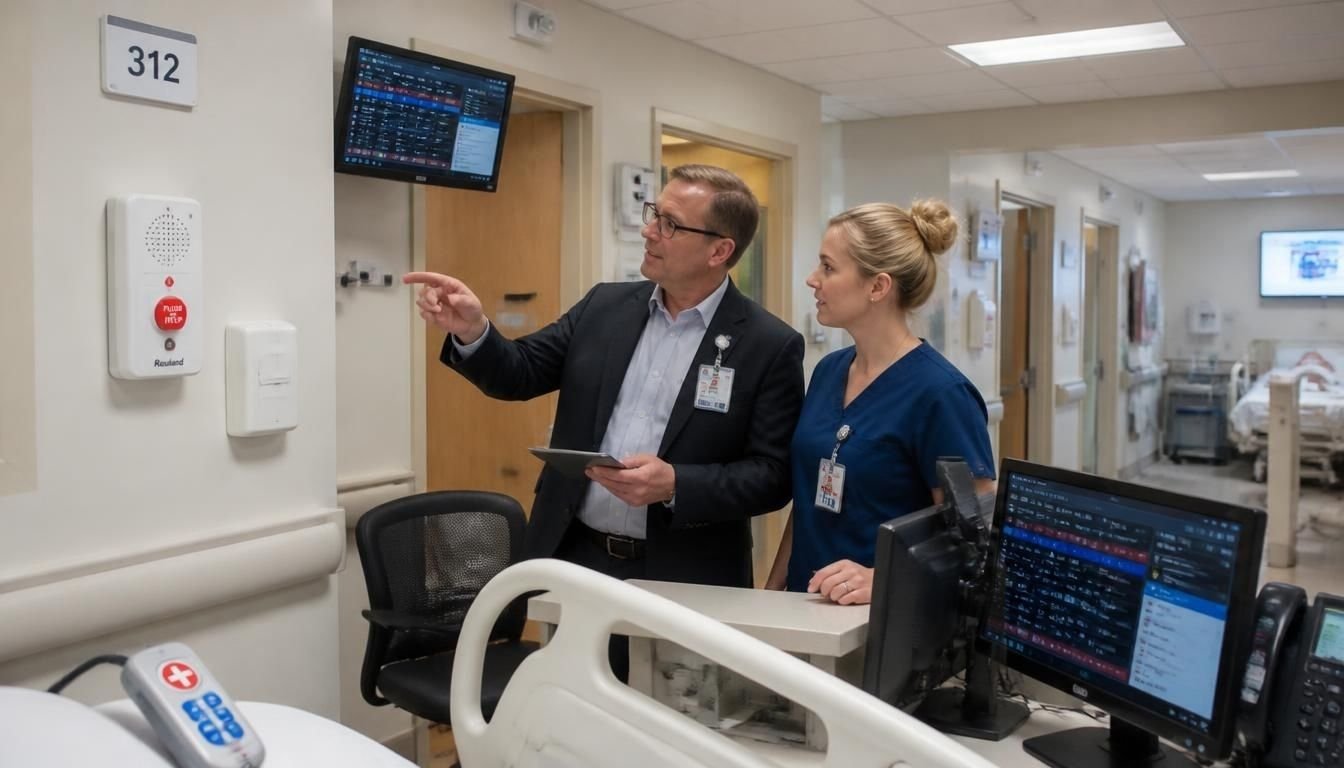
A nurse call system feasibility study determines whether a proposed communication system can meet a healthcare facility’s needs safely, technically, and financially. It examines the existing infrastructure, staff workflows, installation requirements, and long-term operating costs before the facility commits to a purchase or replacement project.
The phrase illinois feasibility study launched nurse call systems may refer to research into a new system or a public-sector project involving nurse call technology. These are different activities. A procurement announcement does not automatically mean that a formal feasibility study has been launched.
Illinois has documented several nurse call system projects. In 2024 the Illinois Department of Veterans Affairs pursued software to make an existing Hillrom nurse call system mobile at the Quincy Veterans Home. Cook County also approved a 2025 contract extension related to nurse call and overhead paging system replacement at Provident Hospital. 25-497DVA-QUINC-B-45389+1
These projects illustrate why facilities need to assess both new technology and the systems already in place.
Why healthcare facilities commission feasibility studies
A study is especially useful when a hospital or long-term care facility is considering:
- Replacing an outdated nurse call system.
- Adding mobile alerts for nurses and other caregivers.
- Expanding a facility or adding patient rooms.
- Connecting nurse call technology with paging or staff communication systems.
- Reducing recurring maintenance problems.
- Improving call visibility, escalation, and response monitoring.
The objective is to identify the most suitable approach before procurement and installation begin.
What the Illinois Project Landscape Reveals
Illinois healthcare facilities may have very different requirements depending on their size, ownership, patient population, and existing equipment. A solution that works in a small residential care facility may not satisfy the communication needs of a large hospital.
Public procurement records provide useful examples of the types of decisions involved.
| Documented project | What it involved | Feasibility lesson |
|---|---|---|
| Quincy Veterans Home | Software to support mobile use of an existing Hillrom nurse call system | Assess whether an upgrade can extend existing equipment’s capabilities |
| Provident Hospital in Chicago | Nurse call and overhead paging system replacement | Evaluate communication infrastructure and installation requirements together |
| Illinois Veterans Home in Chicago | Nurse emergency call light inspection, testing, maintenance, and repair procurement | Include ongoing reliability and service costs in the assessment |
The projects above are documented procurement activities, not evidence of a newly launched statewide feasibility study. 25-497DVA-QUINC-B-45389+2
For facility administrators, the practical lesson is to define the problem first. A system replacement may be necessary in one building, while a software upgrade, targeted repair, or phased expansion may be more appropriate in another.
The Main Components of a Nurse Call Feasibility Study
A useful assessment covers more than the equipment catalog. It examines the full communication process, from a patient requesting assistance to a caregiver receiving and responding to that request.
1. Existing system and infrastructure assessment
The first step is documenting the current installation.
The assessment should identify:
- Bedside call buttons and bathroom pull cords.
- Corridor indicator lights and annunciators.
- Central master stations and control equipment.
- Existing cabling, network connections, and power supplies.
- Mobile devices and staff communication tools.
- Equipment age, maintenance history, and parts availability.
The team should also identify recurring faults and devices that no longer meet operational needs.
For example, a facility might discover that its bedside buttons still work reliably but that staff cannot receive alerts outside designated workstations. This could support an assessment of mobile communication options instead of immediate replacement of the entire system.
2. Clinical workflows and staff requirements
A technically compatible system is not necessarily a good operational fit.
Administrators should interview nurses, nursing assistants, maintenance personnel, and department managers to identify how calls are handled during different shifts.
Questions should include:
- Who receives each type of call?
- How are urgent calls distinguished from routine requests?
- What happens when the assigned caregiver does not respond?
- Can calls be transferred when staff members are unavailable?
- How are missed calls and recurring delays reviewed?
- What happens during a network outage or power failure?
The study should document the current workflow and compare it with the proposed one.
This is important because adding mobile notifications without defining responsibility for each alert can create more notifications without improving coordination.
3. Technical compatibility and integration
Nurse call systems may connect with other communication technologies, but compatibility depends on the specific equipment, software, interfaces, and configuration.
A feasibility assessment should determine whether the proposed system can work with:
- Existing nurse call hardware.
- Paging and overhead announcement systems.
- Approved mobile devices and messaging platforms.
- Hospital information systems where integration is required.
- Network infrastructure and backup power.
- Reporting and monitoring tools.
The facility should request written confirmation of supported interfaces from the vendor.
Avoid assuming that two systems can communicate simply because both use IP networking. Confirm the required interfaces, licenses, network capacity, security controls, and testing procedures.
4. Patient safety and system reliability
Nurse call systems support requests for assistance and may also support urgent clinical workflows. Their design and testing therefore require careful attention to reliability.
The assessment should examine:
- Call delivery and acknowledgment.
- Priority handling and escalation.
- Audible and visual alerts.
- Bathroom and bedside coverage.
- Backup power and failure notifications.
- System monitoring and fault reporting.
- Emergency communication procedures during maintenance.
The facility should define measurable acceptance criteria before installation.
For example, a test plan might require every bedside button and bathroom pull cord to generate the correct alert at the intended receiving station. Higher-priority alerts should also be tested according to the approved clinical workflow.
A vendor demonstration alone is not enough. The installed system must be tested under the conditions in which staff will actually use it.
How Much Does a Nurse Call System Project Cost?
The total cost depends on facility size, the number of devices, the existing infrastructure, the chosen system architecture, and the scope of integration.
A feasibility study should produce a project-specific estimate rather than rely on a generic price per bed.
Costs to include in the project budget
| Cost category | What to evaluate |
|---|---|
| Hardware | Controllers, bedside devices, pull cords, indicator lights, and master stations |
| Installation | Labor, wiring, mounting, cabling, and building repairs |
| Software | Licenses, subscriptions, updates, and mobile communication features |
| Network infrastructure | Switches, cabling, wireless coverage, and network changes |
| Integration | Interfaces with paging, messaging, and other required systems |
| Testing and commissioning | Functional testing, documentation, and acceptance checks |
| Staff training | Training across relevant departments and shifts |
| Ongoing maintenance | Service agreements, spare parts, repairs, and technical support |
| Project transition | Temporary procedures, phased installation, and continuity planning |
Why the lowest initial quote may not be the best option
A low-cost system may require additional cabling, separate licenses, or replacement of existing infrastructure. A more expensive solution may reuse compatible equipment or provide a better-supported upgrade path.
Neither option is automatically better.
The facility should compare the total cost over a defined evaluation period. That comparison should include initial investment, recurring fees, maintenance, expected replacements, and any verified operational savings.
Avoid assigning financial value to reduced response times or staff efficiency without a defensible method for estimating and measuring those benefits.
Wired, Wireless, or Mobile-Enabled Nurse Call Systems
The choice depends on the building, existing equipment, reliability requirements, and the communication problems the facility needs to solve.
| Option | Potential advantages | Main considerations |
|---|---|---|
| Wired system | Dedicated connections and suitability for permanent installations | Cabling work, building disruption, and future expansion |
| Wireless system | May reduce new cabling requirements and simplify certain installations | Radio coverage, interference, battery maintenance, and device supervision |
| Mobile-enabled system | Can route supported alerts to staff devices | Network reliability, device management, licensing, and alert escalation |
| Hybrid system | May combine existing wired equipment with newer communication capabilities | Interface compatibility, system complexity, and vendor support |
These options are not mutually exclusive. A facility can retain wired bedside devices while adding a supported mobile communication layer.
A feasibility study should compare the complete proposed configuration, not just the technology category.
How Long Does a Nurse Call System Feasibility Study Take?
There is no universal timeline for every facility. The duration depends on the number of buildings, availability of technical drawings, complexity of existing equipment, and the number of stakeholders involved.
The following are planning estimates for organizing the assessment, not verified Illinois project timelines.
| Assessment activity | Illustrative planning allowance |
|---|---|
| Initial requirements and document review | 1 to 2 weeks |
| Site inspection and workflow assessment | 1 to 2 weeks |
| Technical options and compatibility review | 1 to 3 weeks |
| Cost estimates and risk assessment | 1 to 2 weeks |
| Final report and stakeholder review | 1 week |
Some activities can overlap. A small facility with complete records may need less time, while a large hospital with multiple buildings and complex integrations may require a longer assessment.
The schedule should also account for vendor site visits, procurement requirements, and approvals.
Illinois Procurement and Compliance Considerations
Healthcare facilities in Illinois should distinguish between the technical feasibility of a system and the requirements governing its purchase, installation, and operation.
Public hospitals and state-operated facilities may have formal procurement, approval, and documentation requirements. Private healthcare organizations may follow different purchasing procedures.
Before issuing a request for proposals or selecting a vendor, the project team should confirm the requirements that apply to its facility.
Review the applicable requirements
- Procurement: Determine whether competitive bidding, an approved purchasing process, or a documented exception applies.
- Building and electrical work: Confirm the applicable codes, permits, and inspection requirements with the responsible authorities.
- Healthcare operations: Review facility-specific patient safety policies and procedures.
- Cybersecurity and privacy: Evaluate network access, user permissions, data transmission, and vendor remote access where applicable.
- Accessibility and coverage: Confirm that the proposed design serves the intended patient rooms, bathrooms, and care areas.
- Maintenance: Establish inspection schedules, fault reporting, service response expectations, and recordkeeping requirements.
Do not assume that a single standard or approval covers every nurse call installation in Illinois. Requirements can vary with facility type, project scope, and the authority having jurisdiction.
Expert Decision Framework for Illinois Healthcare Facilities
The most suitable option depends on the actual problem, not the age of the equipment alone.
Use the following framework to guide the decision.
When to repair the existing system
Repair may be appropriate when the system remains supported, faults are limited, replacement parts are available, and testing confirms that it meets current operational requirements.
Before choosing repair, obtain a condition assessment and estimate recurring maintenance costs. Repeated failures or discontinued components can make continued repairs a poor long-term investment.
When to upgrade the existing system
An upgrade may be appropriate when the underlying equipment is reliable but the facility needs additional capabilities, such as mobile alerts or improved reporting.
The critical requirement is verified compatibility. Confirm which existing components can remain in service and which will need replacement.
When to replace the entire system
Full replacement may be appropriate when the equipment is no longer supported, the infrastructure cannot meet current requirements, faults are widespread, or the proposed upgrade would create excessive technical complexity.
Replacement planning should include installation phasing and a tested method for maintaining call coverage throughout the transition.
When to use a pilot project
A pilot may be appropriate when a facility wants to test mobile notifications, alert routing, reporting, or a new workflow before deploying it across the building.
Select a representative care area and define success measures in advance. These might include successful alert delivery, acknowledgment time, escalation performance, staff usability, and the number of unresolved faults.
A pilot should test the actual intended configuration. Results from a small test area should not automatically be treated as proof that the system will perform identically across an entire hospital.
What the final feasibility report should contain
Before approving the project, administrators should expect a report containing:
- A documented assessment of existing equipment and infrastructure.
- Clinical and operational requirements.
- A comparison of technically viable options.
- A project-specific budget and ongoing cost estimate.
- Identified safety, integration, cybersecurity, and operational risks.
- A recommended implementation approach and schedule.
- Testing, training, maintenance, and acceptance requirements.
The recommendation should explain why the selected option best fits the facility’s requirements and what evidence supports the decision.
Frequently Asked Questions
What does an Illinois nurse call system feasibility study determine?
It determines whether a proposed nurse call system or upgrade is suitable for a particular healthcare facility. The assessment considers existing infrastructure, clinical workflows, technical compatibility, safety, costs, and ongoing maintenance.
Has Illinois launched a statewide nurse call system feasibility study?
The public records reviewed document specific nurse call procurement and replacement activities, including projects involving the Quincy Veterans Home and Provident Hospital. They do not establish that Illinois has launched a new statewide nurse call system feasibility study. A specific announcement or project document would be needed to confirm that claim. 25-497DVA-QUINC-B-45389+1
Why would a hospital conduct a feasibility study before replacing nurse call equipment?
The study helps identify compatibility problems, installation costs, operational risks, and alternatives before the hospital commits funds. It can also establish requirements for testing, training, and maintaining communication during installation.
Can a facility upgrade its nurse call system without replacing every device?
Yes, when the existing equipment is supported and compatible with the proposed upgrade. The vendor should verify the supported configuration and identify any components that must be replaced.
Are wireless nurse call systems better than wired systems?
Not in every situation. Wireless systems may reduce certain cabling requirements, while wired systems may suit buildings with established infrastructure. Coverage, reliability, maintenance, installation disruption, and lifecycle costs should determine the choice.
What should an Illinois facility include in a nurse call system budget?
The budget should include equipment, installation, software, network changes, integration, commissioning, staff training, maintenance, and transition planning. Recurring fees and future replacement costs should also be considered.
How can a hospital evaluate nurse call system reliability?
The facility should establish measurable acceptance criteria and test every relevant device and alert pathway. Testing should include call delivery, acknowledgment, escalation, fault reporting, and backup procedures.
Does a nurse call system need to integrate with mobile devices?
Not always. Mobile integration can help staff receive alerts away from fixed stations, but its value depends on clinical workflows and infrastructure. The feasibility study should determine whether mobile communication addresses a documented need and whether the proposed integration is supported.
What should administrators request from a nurse call system vendor?
Request a detailed equipment list, compatibility statement, installation scope, itemized pricing, software and licensing terms, warranty details, maintenance commitments, training plan, testing procedures, and implementation schedule.
When should a facility commission a feasibility study?
A study is particularly useful before a major replacement, building expansion, mobile communication upgrade, or investment in new integrations. It is also worth considering when repeated failures or rising maintenance costs make the existing system difficult to sustain.