
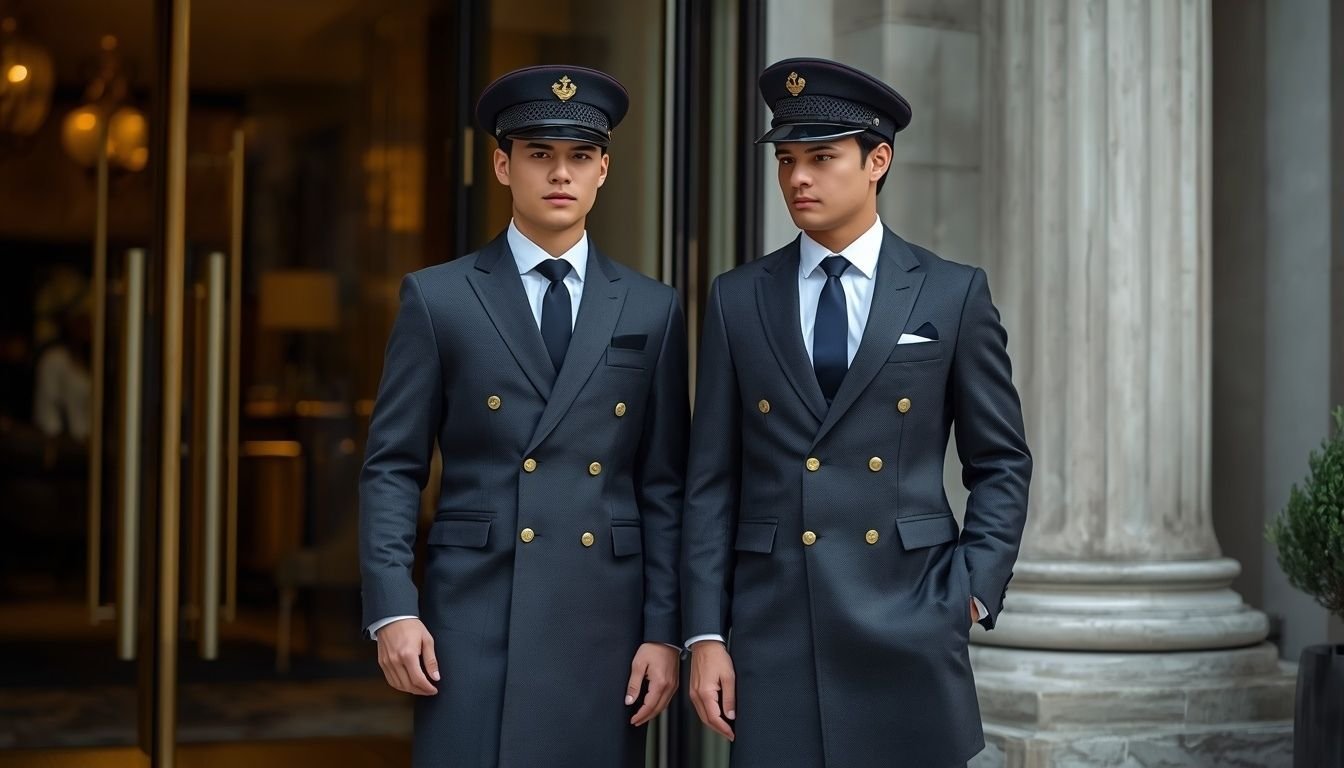
Professional doorman attire is an important part of the hospitality uniform market. Hotels, luxury residential buildings, resorts, casinos and commercial properties rely on professional entrance staff to create a welcoming first impression. Their uniforms need to reflect the property’s identity while supporting comfort, durability and consistent presentation throughout the workday.
A b2b uniform supplier for professional doorman attire industry report helps purchasing managers, hospitality operators, uniform distributors and apparel manufacturers understand the business opportunities and purchasing requirements in this specialized segment.
The market covers more than traditional doorman coats. It includes tailored jackets, dress trousers, formal shirts, waistcoats, caps, gloves, ties and weather-appropriate outerwear. Buyers increasingly need suppliers that can provide coordinated collections, consistent sizing, custom branding and reliable repeat orders.
This report examines the US market landscape, purchasing models, product requirements, supplier capabilities and the factors that influence successful B2B uniform procurement.
Key Takeaways
- Professional doorman uniforms combine hospitality branding with practical requirements for daily work.
- Hotels and luxury properties need consistent attire across doormen, valets, bellhops and concierge teams.
- B2B buyers can choose between ready-made uniforms, custom manufacturing and managed uniform programs.
- Fabric quality, sizing, customization, minimum orders and delivery reliability influence supplier selection.
- Long-term purchasing decisions should account for replacement costs, inventory management and consistent reordering.
The US Market for Professional Doorman Uniforms
Doorman attire sits within the broader uniform and brand identity apparel industry. Its demand is connected to hospitality operations, luxury property management, commercial real estate and visitor-facing services.
Unlike general workwear, professional doorman clothing has a strong visual component. Employees often work at entrances, driveways, hotel lobbies and other highly visible locations. Their appearance contributes to the property’s overall service identity.
Main industries purchasing doorman uniforms
| Industry | Typical uniform requirements | Main purchasing priorities |
|---|---|---|
| Luxury hotels | Formal coats, tailored trousers, caps and accessories | Premium appearance and brand consistency |
| Boutique hotels | Custom jackets, shirts and coordinated accessories | Distinctive design and smaller production runs |
| Residential buildings | Blazers, dress shirts and seasonal outerwear | Professional appearance and durability |
| Resorts | Lightweight formal attire and weather-appropriate clothing | Comfort and seasonal flexibility |
| Casinos | Coordinated formal uniforms and branded accessories | Consistent appearance across departments |
| Commercial properties | Business attire and practical outerwear | Cost control and reliable replacement |
The customer base includes both independent properties and large hospitality groups. Their procurement requirements can differ considerably.
An independent hotel may need a small customized order. A national property management company may require standardized garments for multiple locations with centralized purchasing and repeat deliveries.
What Buyers Expect From a Professional Doorman Uniform Supplier
B2B buyers need more than a catalog of formal clothing. They need a supplier capable of understanding the property’s service environment and delivering uniforms that maintain a consistent appearance.
1. Formal and tailored garment options
Traditional doorman attire often includes:
- Structured doorman coats
- Single-breasted and double-breasted blazers
- Tailored dress trousers
- Formal button-down shirts
- Waistcoats and matching vests
- Branded ties and neckwear
- Professional doorman caps
- Dress gloves and coordinated accessories
Luxury properties may request distinctive details such as brass buttons, embroidered crests, contrast piping and custom lapels.
The supplier should be able to reproduce approved designs across future orders.
2. Consistent sizing across the workforce
Sizing is a major purchasing consideration for hospitality teams. Employees may have different body types and fit preferences.
A capable supplier should provide:
- Detailed US sizing charts
- Regular and extended sizes
- Tall and short options where available
- Sample garments for fitting
- Size exchanges under agreed conditions
- Consistent measurements across repeat orders
For large hotel groups, maintaining a standard fit is particularly important. A replacement jacket should match the original uniform rather than introduce noticeable differences.
3. Custom branding and finishing
Professional entrance staff represent the property’s identity. Branding should therefore look integrated into the garment rather than added as an afterthought.
Common customization options include:
- Embroidered hotel logos
- Custom buttons and insignia
- Woven brand labels
- Personalized name badges
- Custom color combinations
- Embroidered department identification
Buyers should approve logo placement and thread colors before bulk production begins.
Fabric and Construction Requirements for Doorman Attire
Doorman uniforms often combine formal tailoring with the practical demands of daily hospitality work.
The appropriate material depends on the climate, work environment, laundering arrangements and expected appearance.
Comparing common uniform fabrics
| Fabric | Main advantages | Potential limitations | Suitable applications |
|---|---|---|---|
| Wool | Refined appearance and natural temperature regulation | Higher cost and care requirements | Luxury formal coats |
| Wool-polyester blend | Structured appearance with improved practicality | Quality varies by blend | Premium jackets and trousers |
| Polyester-viscose | Smooth finish and crease retention | Breathability depends on construction | Front desk and doorman suits |
| Cotton twill | Comfortable and durable construction | Can wrinkle and shrink if poorly specified | Casual formal uniforms |
| Cotton-polyester | Balanced comfort and easier maintenance | May feel less premium | Everyday hospitality attire |
| Stretch fabric blends | Improved movement and flexibility | Excessive stretch can affect garment structure | Active entrance and valet teams |
Fabric selection should account for more than appearance.
For example, a doorman working outside a hotel entrance in Chicago during winter needs different clothing from an employee stationed inside a climate-controlled hotel lobby in Miami.
Seasonal uniform planning
A complete uniform program should consider seasonal conditions.
Winter requirements
- Insulated overcoats
- Weather-resistant outerwear
- Warm gloves
- Appropriate headwear
- Layering options for outdoor shifts
Summer requirements
- Lightweight blazers
- Breathable dress shirts
- Moisture-managing fabrics
- Lighter fabric weights
- Comfortable trousers
Properties with outdoor entrance teams should also consider rain protection and practical footwear policies.
B2B Sourcing Models and Supplier Types
Not every uniform supplier operates the same way. Understanding the available purchasing models helps businesses choose a supplier that fits their order volume and operating requirements.
Direct manufacturers
Direct manufacturers produce garments according to a buyer’s specifications.
They are particularly useful for:
- Luxury hotel groups
- Custom doorman coat programs
- Multi-property hospitality operators
- Buyers requiring distinctive designs
- Businesses planning recurring bulk purchases
A direct manufacturing relationship can provide greater control over fabric selection, construction, branding and garment specifications.
However, custom manufacturing may involve sampling expenses, production minimums and longer lead times.
Wholesale uniform distributors
Wholesale distributors supply ready-made garments from established apparel brands or manufacturing partners.
Their main advantages include:
- Access to existing uniform collections
- Lower barriers for smaller orders
- Multiple garment options
- Faster access to stocked products
- Easier replacement purchasing
The main limitation is that buyers may have less control over garment design and fabric specifications.
Managed uniform rental programs
Rental programs provide garments and ongoing services through an agreed commercial arrangement.
Depending on the provider, services may include:
- Scheduled garment delivery
- Laundry and maintenance
- Garment replacement
- Inventory tracking
- Employee uniform management
This model can work for properties that need regular garment servicing and do not want to manage all inventory internally.
However, rental availability for specialized formal doorman attire should be confirmed before entering a contract. A standard industrial uniform rental program may not offer the tailored styles required by luxury hospitality properties.
Comparison of B2B purchasing models
| Purchasing model | Customization | Initial commitment | Ongoing management |
|---|---|---|---|
| Direct manufacturing | High | Usually higher | Buyer manages inventory and reorders |
| Wholesale distribution | Low to moderate | Often lower | Buyer manages inventory |
| Uniform rental | Depends on provider | Contract-based | Provider handles agreed services |
| Custom uniform program | High | Project-dependent | Shared supplier and buyer responsibilities |
Industry Trends Influencing Professional Hospitality Uniforms
The broader uniform market is changing as businesses place greater importance on employee comfort, brand presentation and procurement efficiency.
Market size and growth outlook
The global uniform and brand identity apparel market was estimated at approximately $15.4 billion in 2025. It is projected to reach $24.1 billion by 2033, with an estimated compound annual growth rate of 5.8% between 2026 and 2033.
North America accounted for 33.2% of the global market in 2025. Within the North American market, the United States represented approximately 65.7% of revenue.
These figures cover the wider uniform and brand identity apparel industry. They should not be interpreted as the market size of doorman uniforms alone. Grand View Research
For suppliers, this broader market provides context for opportunities in hospitality clothing, branded apparel and managed uniform services.
Demand for comfortable and tailored designs
Hospitality operators increasingly want uniforms that balance professional appearance with employee comfort.
Important design considerations include:
- More flexible garment construction
- Breathable materials
- Improved garment fit
- Wrinkle-resistant fabrics
- Inclusive sizing
- Modern formal silhouettes
A traditional uniform can still look elegant without restricting movement during a full shift.
Greater attention to sustainable materials
Environmental considerations are becoming part of corporate apparel procurement.
Some hospitality buyers evaluate:
- Recycled polyester
- Responsibly sourced natural fibers
- Durable garments with longer service lives
- Repair and replacement options
- Supplier manufacturing practices
Sustainability claims should be supported by material documentation or credible certifications rather than general marketing language.
Consolidated supplier relationships
Managing several uniform vendors can create administrative problems for hotel groups.
Different suppliers may use different sizing standards, production schedules, pricing structures and replacement policies.
A consolidated supplier relationship can simplify:
- Purchase order management
- Brand consistency
- Inventory planning
- Employee onboarding
- Replacement garment purchasing
This is especially relevant for operators with multiple properties or departments.
Hospitality procurement discussions have also highlighted the difficulty of managing multiple supplier contracts and the value of coordinated uniform programs. Foodbuy Hospitality
The Commercial Requirements of a B2B Uniform Supplier
A supplier serving professional doorman programs needs reliable operational capabilities in addition to suitable garments.
Minimum order quantities
Minimum order quantities vary according to the supplier’s business model and production arrangements.
Ready-made products may be available in relatively small quantities. Custom manufacturing generally requires a larger commitment because materials, patterns, sampling and production need to be organized.
A buyer should ask whether minimum quantities apply:
- Per garment style
- Per color
- Per fabric
- Per logo or embroidery design
- Across the complete purchase order
For example, a hotel ordering coats, shirts and trousers should establish whether the supplier allows different garment styles to count toward one combined minimum.
Production and delivery timelines
Production schedules depend on garment complexity, material availability, sample approval and order volume.
The following figures are planning examples rather than guaranteed industry standards.
| Order type | Planning consideration |
|---|---|
| Ready-made stock | Confirm available sizes and inventory before payment |
| Stock with embroidery | Allow time for branding and quality checks |
| Existing custom design | Confirm fabric availability and production capacity |
| New custom design | Include pattern development and sample approval |
| Multi-property rollout | Allow additional time for sizing coordination and distribution |
Some hospitality suppliers publish standard production windows of approximately four to six weeks for approved custom orders. More complex projects can take longer. FAQ’s
Buyers should obtain written delivery dates rather than relying on general estimates.
Quality assurance and production consistency
Quality control should cover the entire production process.
Important inspection points include:
- Fabric color and weight.
- Stitching strength and seam finishing.
- Button attachment and hardware quality.
- Garment measurements.
- Embroidery position and accuracy.
- Color consistency between garments.
- Final appearance after pressing.
A pre-production sample is particularly valuable for large or customized orders.
It gives the buyer an opportunity to identify fitting, material and design problems before the supplier manufactures the full quantity.
How B2B Buyers Evaluate Supplier Pricing
The price of professional doorman attire depends on garment specifications and the supplier’s production model.
A basic ready-made blazer and a custom-manufactured luxury doorman coat are not directly comparable products.
Factors that influence wholesale pricing
1. Fabric selection
Premium wool, specialty blends and imported fabrics generally have different costs from standard polyester and cotton blends.
2. Garment construction
Structured coats, custom lapels, reinforced seams and specialized tailoring require additional production work.
3. Order quantity
Larger orders may reduce the cost per garment by spreading setup and production expenses across more units.
4. Customization
Embroidery, custom buttons, woven labels and branded accessories can increase the total order value.
5. Shipping and fulfillment
Domestic and international production arrangements can create different shipping costs, customs requirements and delivery schedules.
Calculating the total cost of ownership
Purchasing managers should evaluate more than the initial garment price.
A useful calculation is:
Total uniform program cost =
- Initial garment purchases
- Customization and sampling
- Shipping and fulfillment
- Alterations and fitting
- Replacement garments
- Cleaning and maintenance
- Inventory storage and administration
For example, a lower-priced jacket may require frequent replacement if its fabric loses shape or its buttons become damaged.
A more expensive garment could offer better long-term value if it maintains its appearance through regular use and appropriate care.
Actual savings should be evaluated using supplier quotations and expected garment replacement rates.
Where to Find B2B Uniform Suppliers for Professional Doorman Attire
US buyers can explore several supplier categories when sourcing professional entrance uniforms.
The best option depends on the required design, order volume, delivery location and level of customization.
Specialized hospitality uniform manufacturers
Specialized manufacturers are worth considering when a property needs formal doorman coats, matching accessories or custom garment specifications.
Examples of suppliers and manufacturers serving this market include:
- J.A. Uniforms: Offers custom hospitality and casino uniforms, including doorman, bellman and valet apparel.
- W.H. Christian & Sons: Provides career apparel and accessories for doormen, concierge teams and lobby attendants.
- KAPTVA Apparel: Focuses on casino and hospitality uniforms with custom design and bulk ordering options.
- Stock MFG Co.: Offers hotel uniform collections and custom uniform program services.
- At Work Uniforms: Provides hospitality and gaming apparel, including front-of-house uniforms.
These businesses have different product ranges and operating models. Buyers should confirm current availability, minimum quantities, manufacturing arrangements and delivery capabilities directly with each supplier.
The presence of a doorman uniform in a supplier’s catalog does not automatically establish that it can support a complete multi-property uniform program.
Questions to ask before requesting a quotation
A professional supplier inquiry should include:
- Do you manufacture doorman coats or distribute existing products?
- Can you produce custom designs from reference garments?
- What fabrics are available?
- Can you provide samples before bulk production?
- What is the minimum order quantity per style?
- Can you accommodate extended and mixed sizing?
- Do you provide custom embroidery and accessories?
- What are your standard production and shipping timelines?
- Can you support repeat orders using approved specifications?
- What happens if garments arrive with sizing or manufacturing defects?
These questions help distinguish suppliers with genuine production capabilities from businesses that primarily resell standard apparel.
Expert Purchasing Framework: Choosing the Right Doorman Uniform Supplier
Selecting a supplier should begin with the property’s operational requirements rather than the lowest available quotation.
A b2b uniform supplier for professional doorman attire industry report should help buyers evaluate the commercial and practical factors that influence sourcing decisions.
The following framework provides a useful approach.
Step 1. Define the property’s uniform requirements
Identify the actual working environment.
A luxury hotel entrance may require traditional formal coats and matching caps. A modern residential building may prefer business-casual blazers with lightweight outerwear.
Document:
- Employee headcount
- Garments required per employee
- Indoor and outdoor responsibilities
- Seasonal requirements
- Brand colors and design standards
- Expected replacement frequency
Step 2. Decide between stock and custom manufacturing
| Business requirement | Recommended approach |
|---|---|
| Small team with standard requirements | Ready-made uniforms |
| Luxury property with distinctive branding | Custom manufacturing |
| Multiple properties with identical designs | Standardized custom program |
| Frequent employee replacement needs | Stock garments with repeat availability |
| Long-term garment servicing | Managed rental program |
Custom manufacturing is not automatically the better option.
If a business needs only a few standard jackets, an existing collection may provide better value and faster delivery.
Custom manufacturing becomes more attractive when the design, fit or branding requirements cannot be met through available products.
Step 3. Compare suppliers using measurable criteria
A purchasing team can use the following evaluation model.
| Evaluation factor | Suggested weight |
|---|---|
| Product quality and construction | 25% |
| Consistent sizing and fit | 20% |
| Production and delivery reliability | 20% |
| Pricing and total ownership cost | 15% |
| Customization capabilities | 10% |
| Replacement and customer support | 10% |
| Total | 100% |
These are suggested purchasing weights, not measured industry benchmarks.
A supplier with a slightly higher quotation may be a better choice if it offers stronger quality control, dependable delivery and reliable replacement support.
Step 4. Approve a sample before bulk purchasing
Never rely entirely on product photographs when purchasing customized formal uniforms.
Request a physical sample and check:
- Fabric quality
- Fit and movement
- Stitching and finishing
- Color accuracy
- Button and accessory quality
- Logo placement
- Comfort during extended wear
If possible, have employees test the garments during normal working conditions.
Step 5. Establish a repeat-order agreement
A successful first order does not guarantee consistent future deliveries.
Buyers should establish a documented uniform specification that includes:
- Approved garment models
- Fabric composition
- Color references
- Size measurements
- Branding specifications
- Approved sample photographs
- Replacement requirements
- Reorder pricing arrangements
This makes future purchasing easier and reduces the risk of receiving garments that look different from the original order.
Frequently Asked Questions
What does a B2B doorman uniform supplier provide?
A B2B supplier provides professional entrance staff clothing in commercial quantities. Products can include doorman coats, blazers, trousers, formal shirts, caps, gloves, ties and branded accessories. Some suppliers also offer custom manufacturing, embroidery and ongoing uniform management.
How do hotels choose a professional doorman uniform supplier?
Hotels should compare product quality, garment construction, sizing consistency, customization options, minimum order quantities and delivery reliability. Sample approval and repeat-order capabilities are particularly important for properties that need consistent uniforms throughout the year.
What is the difference between a uniform manufacturer and a wholesale distributor?
A manufacturer produces garments according to specifications or established designs. A wholesale distributor purchases and resells existing products from manufacturers or apparel brands. Manufacturers generally provide greater customization, while distributors can offer easier access to ready-made inventory.
What is the typical minimum order for custom doorman uniforms?
There is no universal minimum order quantity. Requirements depend on the manufacturer, garment design, fabric and production method. Buyers should request minimum quantities per style and color before preparing a purchase order.
Can suppliers manufacture custom luxury doorman coats?
Yes. Specialized apparel manufacturers can develop custom coats using selected fabrics, tailored patterns, embroidered insignia, branded buttons and other design features. Buyers should request samples and written production specifications before approving bulk manufacturing.
What should buyers include in a doorman uniform quotation request?
A quotation request should include garment types, estimated quantities, sizes, fabric preferences, brand colors, logo files, customization requirements, delivery location and required delivery date. Reference photographs can also help suppliers understand the expected design.
How long does custom doorman uniform production take?
Production time varies by supplier and project complexity. Existing designs may require less time than new custom garments. Buyers should account for sampling, design approval, material sourcing, manufacturing, inspection and shipping when establishing a project schedule.
Is buying uniforms better than renting them?
Buying can be suitable for properties that want ownership of formal attire and control over garment specifications. Rental can be more practical when regular cleaning, maintenance and replacement services are important. The best option depends on service availability, contract costs and the type of clothing required.
What makes a supplier suitable for a multi-property hotel group?
A suitable supplier should maintain consistent garment specifications, support centralized ordering, manage different employee sizes and provide reliable repeat production. The ability to coordinate deliveries across multiple properties is also important.
What are the main growth opportunities for professional doorman uniform suppliers?
Potential opportunities include custom luxury hospitality clothing, multi-property uniform programs, inclusive sizing, sustainable fabrics, branded accessories and coordinated entrance staff collections. Suppliers that combine garment quality with dependable procurement support can address a broader range of B2B purchasing needs.
Final Purchasing Considerations for Hospitality Uniform Programs
Professional doorman attire is a specialized segment of the wider hospitality uniform market. Its commercial value comes from the combination of formal presentation, garment performance and consistent brand identity.
For independent hotels, ready-made uniforms may provide the most practical starting point. Luxury properties may benefit from custom manufacturing when appearance and design differentiation are priorities. Larger hospitality groups should place greater emphasis on standardized specifications, repeat production and centralized purchasing.
The most suitable supplier is one that can demonstrate garment quality through samples, provide clear commercial terms and maintain consistent standards across future orders.
For purchasing managers, the priority should be building a dependable uniform program rather than simply finding the lowest-priced doorman coat.