
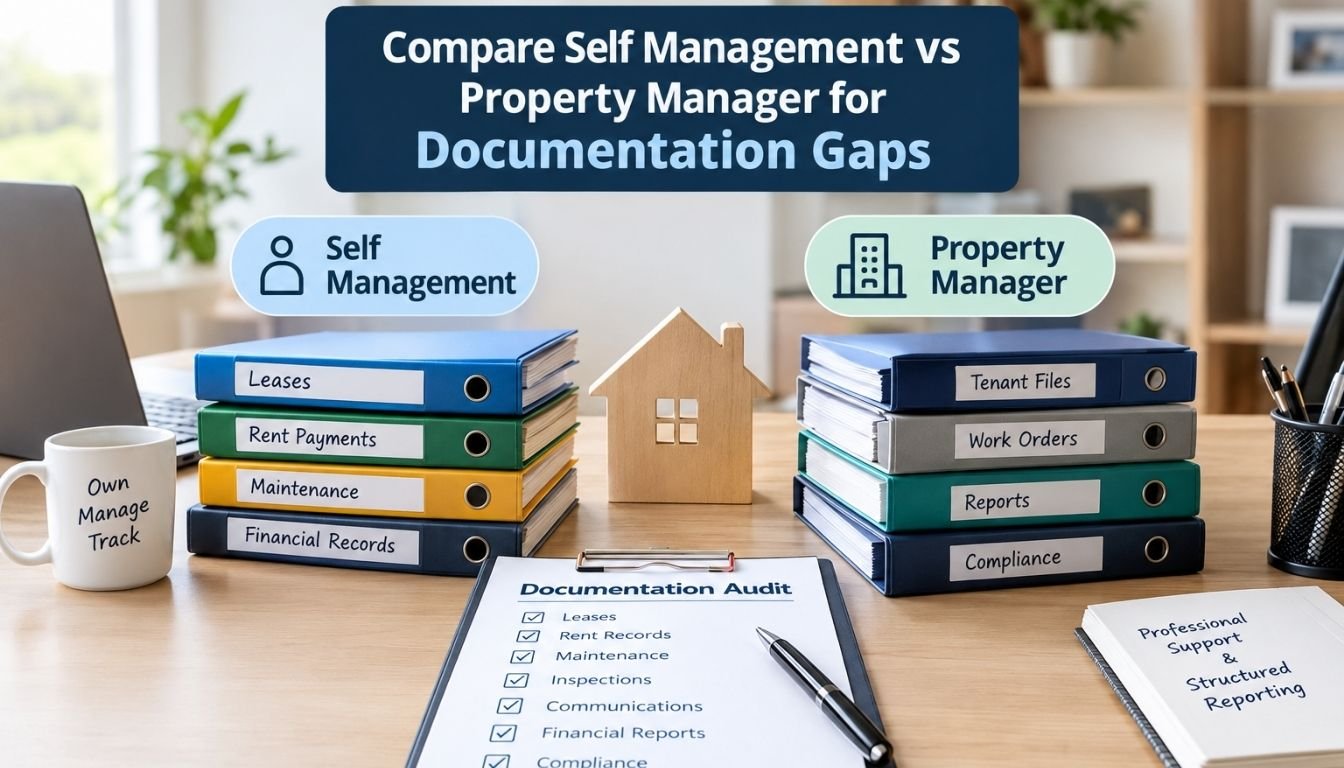
Rental property records do more than keep paperwork organized. They help owners verify rent payments, track maintenance costs, document tenant communication and support tax reporting. When a dispute or inspection arises, complete records can make it easier to establish what happened and when.
The decision to compare self management vs property manager for documentation gaps is different from simply comparing management fees. The real question is which arrangement can maintain accurate, complete and accessible records without leaving important responsibilities unattended.
Self-managing landlords can maintain excellent documentation with a reliable process. Professional property managers can also have gaps if they fail to record transactions, communicate decisions or provide owners with the necessary files.
The best option depends on the current condition of your records, the time available to maintain them and the level of accountability built into your management process.
Key Takeaways
- Self-management gives landlords direct control over records but requires consistent organization and follow-up.
- A property manager can provide structured reports and documentation, but record quality depends on their systems and contract.
- Missing leases, repair receipts, inspection reports and payment records can create financial and legal problems.
- Property owners should retain access to original documents and accounts even when management is outsourced.
- A documentation audit helps determine whether better internal processes or professional management will solve the problem.
Which Rental Property Documents Are Most Likely to Be Missing?
Documentation gaps can occur under either management arrangement. The most useful first step is to identify the records that are missing, incomplete or difficult to verify.
Essential records to check
| Record category | Documents to maintain | What a gap can cause |
|---|---|---|
| Lease and tenant files | Signed lease, addenda, renewal dates and move-in records | Disputes over rental terms |
| Rent and deposits | Payment ledger, receipts, deposit records and refund details | Unreconciled balances and accounting errors |
| Repairs and maintenance | Work orders, invoices, receipts and completion notes | Unverified expenses and recurring repair issues |
| Inspections | Move-in condition reports, photographs and follow-up inspections | Difficulty establishing property condition |
| Tenant communication | Written notices, maintenance requests and responses | Unclear timelines and unresolved complaints |
| Financial reporting | Monthly statements, bank records and expense classifications | Inaccurate financial summaries |
| Compliance | Applicable licenses, registrations, required notices and inspection records | Missed deadlines or noncompliance |
| Insurance and incidents | Policies, claim correspondence, incident reports and supporting photographs | Delays in evaluating or supporting claims |
Not every property requires every document listed above. Requirements vary by property type, state and local jurisdiction. Owners should identify the records required for their specific rental and keep additional documents that support their financial and operational decisions.
Self-Management vs. Property Manager for Documentation Gaps
The main difference is who creates, checks and maintains the records. Self-management places these tasks directly on the owner. Professional management delegates agreed responsibilities to a third party.
Neither approach automatically guarantees complete files.
| Documentation factor | Self-management | Professional property manager |
|---|---|---|
| Record creation | Owner prepares and saves documents | Manager records activities within their workflow |
| Financial tracking | Owner reconciles rent and expenses | Manager supplies reports and transaction details |
| Maintenance records | Owner follows up with vendors | Manager coordinates work and collects available records |
| Tenant communication | Owner maintains messages and notices | Manager maintains communication records under the agreement |
| Compliance tracking | Owner monitors applicable requirements | Manager may assist with assigned compliance tasks |
| Access to documents | Depends on the owner’s filing system | Depends on the management platform and contract |
| Accountability | Owner monitors their own process | Owner monitors performance against agreed duties |
| Handover | Owner organizes files for future use | Manager must provide agreed records during a transition |
The most important distinction is not whether the owner or manager holds the paperwork. It is whether each record is complete, accurate, accessible and linked to the activity it documents.
When self-management creates documentation gaps
Self-management often becomes difficult when recordkeeping depends on memory rather than a repeatable process.
For example, an owner may receive a repair invoice by email, approve the work through text messages and pay through a bank transfer. The payment exists, but the property file may not contain the original invoice, the reason for the repair or confirmation that the work was completed.
Common causes include:
- Saving documents across multiple email accounts and devices.
- Recording rent payments without reconciling them against bank deposits.
- Forgetting to document verbal agreements or important tenant conversations.
- Taking inspection photographs without recording dates or property locations.
- Failing to update the file after lease renewals or maintenance visits.
- Leaving tax preparation until the end of the year.
These problems are often process failures rather than evidence that self-management is unsuitable. A consistent folder structure, transaction log and monthly review can resolve many of them.
When a property manager creates documentation gaps
A professional manager may already use software for leases, rent collection, maintenance requests and owner reporting. However, having software does not mean every document is complete or available to the owner.
Potential problems include:
- Work orders marked complete without a final invoice or completion evidence.
- Monthly statements that summarize expenses without attaching supporting documents.
- Vendor invoices stored separately from the related property or work order.
- Tenant notices saved in an internal system that the owner cannot access.
- Inspection reports that identify damage without photographs or follow-up actions.
- Important records remaining in a manager’s account when the contract ends.
The owner may also receive reports without enough detail to reconcile the figures against bank activity.
A manager’s reporting process should therefore be evaluated through actual records rather than promises about technology or experience.
How to Identify Documentation Gaps Before They Become Bigger Problems
A useful audit checks more than whether a file exists. It establishes whether the file is accurate, complete and useful for a future decision.
1. Check whether every required record exists
Start with the lease, payment history, maintenance history, inspection reports and financial statements for each property.
Create a list of missing items. Separate documents that never existed from documents that exist but cannot be located.
This distinction matters because each problem needs a different fix. Missing documentation may require obtaining a copy or reconstructing a timeline. Poor storage may require reorganizing the existing files.
2. Match records to real transactions
Select several rent payments and repair expenses. Trace each one through the relevant documents.
For a repair, the record should ideally connect:
- The original maintenance request.
- The date and reason for the work.
- The approval and agreed cost where applicable.
- The vendor invoice and payment.
- Confirmation that the repair was completed.
For rent, match the amount due against the payment ledger, any applicable late charges and the corresponding bank transaction.
A mismatch should be investigated rather than automatically treated as wrongdoing. Timing differences, refunds and payment processing can explain some discrepancies.
3. Review dates and document versions
An outdated lease, an unsigned addendum or an old insurance policy may be less useful than a complete and current record.
Check that important documents include relevant dates, signatures where required and the correct property details. Confirm that superseded documents remain identifiable without being mistaken for current versions.
For electronic records, use clear filenames and a consistent folder structure. For example, a file might be named Property-A_Repair-Invoice_2026-09-14.pdf.
4. Test access and retrieval
Ask someone who did not create the records to locate a specific repair invoice, lease renewal or tenant payment.
If finding the document requires searching personal messages or contacting the original record keeper, the system may be too dependent on one person.
Owners should be able to retrieve essential records without relying exclusively on a manager’s continued employment or access to a private account.
5. Assign responsibility for every unresolved gap
Each missing record should have an owner, a next action and a due date.
For example, the owner may need to obtain an old lease from the tenant, while the property manager needs to request a missing vendor invoice.
Keep a record of any document that cannot be recovered. Do not create a replacement that falsely appears to be an original or backdate a record. If information must be reconstructed, label it clearly and preserve the evidence used.
A Practical System for Preventing Missing Rental Records
Whether you manage the property yourself or hire a professional, a simple documentation workflow can reduce avoidable gaps.
Step 1. Create one central property file
Maintain a separate digital folder for each property. Organize it into leases, financial records, maintenance, inspections, tenant communications, insurance and compliance. Use restricted access for personal and tenant information.
Step 2. Record activities when they happen
Save invoices when received, record payments when posted and file inspection reports after each inspection. Avoid relying on memory to recreate events weeks later.
Step 3. Review records monthly
Reconcile income and expenses, investigate missing receipts, check open maintenance requests and confirm that important tenant communications have been saved.
Step 4. Protect ownership and access
Keep owner-controlled access to essential files and accounts. Use secure backups, appropriate permissions and a documented process for transferring records when responsibilities change.
Step 5. Review retention requirements
Determine how long financial, lease, deposit and compliance records must be retained under applicable federal, state and local rules. Do not apply one universal retention period to every document.
Which records deserve the highest priority?
Start with documents that support financial reporting, current tenancy, legal deadlines and unresolved property issues.
The Internal Revenue Service explains that rental income and expenses must be supported by appropriate records. Receipts, canceled checks and bills can help substantiate expenses, and inadequate evidence may create problems if a tax return is examined. Rental income and expenses are generally reported on Schedule E for ordinary rental real estate activity, subject to the applicable tax rules.
Owners should also keep records for property improvements separate from ordinary repair expenses because their tax treatment can differ.
For legal compliance, check the actual jurisdiction. Security deposit rules, notice requirements, rental registrations and other obligations may differ by state and municipality.
What Should a Property Management Agreement Say About Documentation?
Hiring a manager does not automatically transfer every responsibility or eliminate the owner’s need to maintain records. The management agreement should explain which records the manager must create, maintain and provide.
Before signing, review these points.
Required documents and reporting frequency
Identify the specific reports and supporting records the manager must deliver. These may include monthly owner statements, rent ledgers, vendor invoices, maintenance histories, inspection reports and copies of relevant tenant notices.
Specify whether supporting documents are supplied automatically or must be requested.
Maintenance approvals and evidence
Clarify the manager’s spending authority, emergency repair procedures and documentation requirements.
For example, the agreement may require invoices and completion notes for routine work, along with prompt notice of emergency expenses. Any spending limits and exceptions should be written clearly.
Owner access and data ownership
Confirm how the owner can access and download records stored in the management platform.
The agreement should address what happens to digital files when the contract ends, including the delivery format, transfer deadline and access to historical records. It should also address the secure handling of tenant information.
Compliance and responsibility
State which party handles specific tasks such as required notices, inspections, registrations and deposit accounting.
The owner should not assume that hiring a manager removes all legal obligations. Responsibility depends on applicable law, the nature of the obligation and the agreement.
Fees for records and transitions
Ask whether document retrieval, special reporting, account closure or file transfers carry additional fees.
A management contract that provides clear records but makes historical files difficult or expensive to retrieve may not meet the owner’s long-term needs.
How Much Does Better Documentation Cost Under Each Option?
The financial comparison should include more than the management fee.
Self-management avoids a professional management charge, but the owner may spend money on software, bookkeeping support and administrative time. Professional management adds contractual fees and may include separate charges for leasing, renewals, repairs or additional services.
| Cost factor | Self-management | Property manager |
|---|---|---|
| Management fee | Usually none for the owner’s own work | Contractual fee |
| Recordkeeping software | Owner pays if needed | May be included or charged separately |
| Bookkeeping support | Optional outside assistance | Depends on the service package |
| Missing-document recovery | Owner’s time or professional assistance | May require additional staff time or fees |
| Annual tax preparation | Depends on the owner’s arrangement | Usually remains a separate service unless included |
| Transition costs | Time spent organizing files | Possible export, transfer or onboarding charges |
There is no reliable universal price for fixing documentation gaps. The cost depends on the number of properties, the volume of missing records, the time needed to reconcile transactions and whether professional accounting or legal help is required.
To compare options fairly, estimate the annual cost of the current process. Include management fees, software, bookkeeping, the owner’s time and the cost of correcting errors. Then compare that amount with a proposed management agreement that specifies the records and services included.
Expert Decision Guide: When to Self-Manage and When to Hire a Property Manager
The best choice depends on the cause of the documentation problem, not simply the number of missing files.
Choose self-management when the problem is mainly organization
Self-management may remain practical when:
- You own a small number of properties and can give them regular attention.
- Most documents already exist but are scattered across emails, spreadsheets and folders.
- You can reconcile payments and expenses consistently.
- You are comfortable coordinating vendors and tracking tenant communication.
- You can monitor applicable legal and tax requirements or obtain qualified help when needed.
In this situation, a central filing system and a recurring monthly review may solve the problem without adding a management fee.
Consider a property manager when the problem is capacity or consistency
Professional management may be worth considering when:
- Important records repeatedly go missing despite attempts to improve the process.
- You live far from the property and cannot easily inspect repairs or respond to incidents.
- Several properties create more administrative work than you can reliably handle.
- You need a consistent process for maintenance, tenant communication and financial reporting.
- You want a defined reporting schedule and a clear point of accountability.
However, do not assume every manager will solve these issues. Ask how the company prevents missing documents, how it handles exceptions and how the owner can verify the quality of its work.
Consider a hybrid approach when only certain tasks are difficult
You do not always need to outsource every responsibility.
Possible arrangements include:
- Hiring a leasing professional to handle tenant placement while you manage ongoing records.
- Outsourcing bookkeeping while retaining direct control over tenant relationships and maintenance.
- Hiring a property manager for distant properties while self-managing nearby rentals.
- Using a maintenance coordinator while retaining financial and compliance oversight.
These arrangements can address a specific weakness without transferring every task to a management company. Make sure each party’s responsibilities are clear and that the records remain connected.
Use this decision checklist before spending money
Documentation readiness
0 of 7I can locate the current lease and all signed addenda.Rental income can be reconciled against payment records.Repair expenses have invoices and payment evidence.Inspection reports and relevant photographs are accessible.Important notices and tenant communications are documented.I can retrieve essential files without depending on one person.Someone is assigned to review and correct missing records.
Start with a documentation audit. Identify missing records before deciding whether new software, outside bookkeeping or a property manager is necessary.
This checklist is a practical screening tool rather than a legal compliance test. A single missing lease, deposit record or time-sensitive notice may deserve immediate attention even if most other records are complete.
Frequently Asked Questions
Is self-management better than a property manager for documentation?
Self-management can work well when the owner has a consistent filing system and enough time to maintain records. A property manager may offer more structured reporting and administrative support, but the quality depends on the company’s processes and contract. Compare the completeness and accessibility of actual records rather than assuming either option is automatically better.
How do I compare self management vs property manager for documentation gaps?
Begin by checking missing leases, payment records, repair invoices, inspection reports and tenant communications. Determine whether the gaps come from poor organization, limited time or an ineffective management process. If a better filing system can solve the problem, self-management may remain practical. If recurring gaps stem from workload or inconsistent execution, professional or partial management may be worth evaluating.
What documents should a landlord keep for tax purposes?
Landlords should retain records that support rental income and deductible expenses. These may include rent ledgers, bank records, receipts, invoices, property tax statements, insurance bills and records of repairs and improvements. The appropriate documents depend on the transaction and tax treatment. Consult a qualified tax professional when an expense classification or reporting requirement is unclear.
Can a property manager be responsible for missing rental records?
A property manager may be contractually responsible for creating or maintaining records assigned to them. Whether missing records constitute a breach or create legal liability depends on the management agreement, applicable law and circumstances. Owners should preserve relevant communications, request the missing files in writing and obtain legal advice if the issue is significant.
How often should rental property records be reviewed?
A monthly review is a useful starting point for income, expenses, maintenance activity and outstanding documentation. Inspect records after major repairs, tenant turnover, lease renewals or incidents that may lead to an insurance claim. Compliance deadlines may require action sooner. The review schedule should match the property’s activities and legal obligations.
What should I do if a previous property manager has missing files?
Request a written inventory of available records and copies of outstanding documents. Identify the gaps by property, transaction and date. Contact vendors, accountants or other relevant parties for legitimate replacement copies where possible. Preserve the original records and label reconstructed information clearly. Review the former management agreement and seek legal advice if access is disputed or essential records remain unavailable.
Does property management software prevent documentation gaps?
Software can centralize files, automate reminders and link payments to transactions. It cannot guarantee accurate entries, complete invoices or proper follow-up. Owners should check user permissions, backup procedures, export options and reporting quality. A simple system used consistently can be more effective than complex software that nobody maintains.
How long should landlords retain rental property records?
There is no single retention period that applies to every rental document. Federal tax recordkeeping rules depend on the type of record and the circumstances, while state and local laws may impose additional requirements for leases, security deposits and notices. Owners should create a retention schedule based on the applicable rules and preserve records connected to unresolved disputes, claims or tax matters.
Keep the Records Strong Before Changing the Management Model
When documentation gaps appear, first establish what is missing and why. If the issue is scattered files or inconsistent habits, improve the process and monitor the results. If the issue is limited capacity, repeated administrative failures or inadequate local oversight, professional management or targeted outside support may provide better control.
The most important requirement is that every essential rental record can be verified and retrieved when needed. Choose the management arrangement that makes that outcome dependable while keeping costs, responsibilities and access to property records clear.