
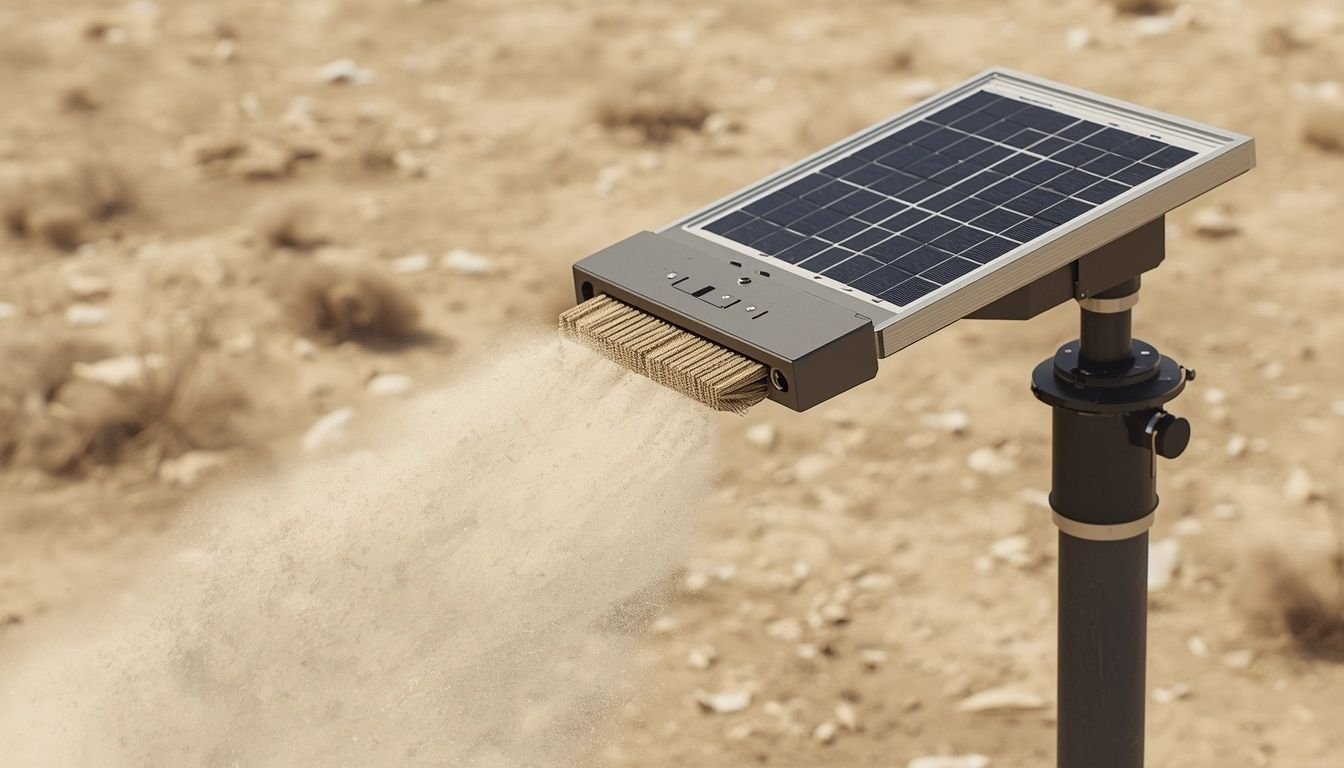
Yes. Self-cleaning street lamp systems have been described in patents and engineering designs. Some approaches use motorized brushes or wipers to remove dust from solar panels. Others focus on surface coatings that make dirt easier to remove.
The important distinction is between an existing design and a proven commercial product. A published patent establishes that a particular design has been documented. It does not establish that the product has been independently tested, installed across a city, or shown to reduce maintenance costs.
The search for a self cleaning street lamp research dust resistant lamp project exist usually reflects three practical questions:
- Has someone already developed a workable system?
- Which technology can keep outdoor lighting equipment clean?
- Is it practical to build or purchase a reliable version?
The answer depends on what needs cleaning. A solar street light may have dust on its photovoltaic panel, LED lens, and outer housing. Each surface requires a different solution.
For a student research project, the most useful starting point is a prototype that measures dust accumulation and cleaning performance under controlled conditions. For a city or property manager, the priority is reliable illumination with manageable maintenance costs.
Key Highlights
- Self-cleaning street lamp technology exists in patented designs and engineering concepts. However a patent does not prove widespread commercial use.
- Mechanical brushes and wipers can remove dust from solar panels and selected lamp surfaces without relying on rainfall.
- Hydrophobic and photocatalytic coatings can reduce dirt adhesion but do not prevent all dust buildup.
- Dust-resistant housing protects internal components while lens cleaning helps maintain light transmission. These are different engineering problems.
- The best design depends on local dust conditions, available power, maintenance access, weather exposure, and long-term operating costs.
How Self-Cleaning Street Lamps Remove Dust
1. Mechanical brushes and wipers
A motor moves a brush or wiper across a solar panel or compatible outer surface. This method physically removes settled dust and can work in dry climates. The main concerns are motor wear, scratches, moving parts, and power consumption.
2. Dust-repellent surface coatings
Hydrophobic coatings encourage water to bead and roll away, potentially carrying loose dirt with it. Their performance depends on coating quality, surface condition, and weather. They are less effective when prolonged dry conditions prevent natural rinsing.
3. Photocatalytic coatings
Certain titanium dioxide coatings use light to break down some organic contaminants and can improve water spreading on treated glass. They are not a universal solution for mineral dust or heavy sand deposits.
4. Dust-resistant housing and lens design
Smooth surfaces, fewer dust-catching ledges, suitable seals, and well-designed enclosures help limit contamination and protect electrical components. These features reduce maintenance needs but do not automatically clean the optical lens.
A complete system may combine several approaches. For example, a solar street light could use a sealed LED enclosure, a smooth solar panel surface, and a small motorized wiper. Combining technologies is useful only when the additional cost and complexity produce a measurable improvement.
What Existing Research and Patents Prove
There are documented engineering designs for self-cleaning solar street lights. The strongest evidence for the existence of this concept comes from patent records describing specific cleaning mechanisms.
One documented design published in August 2022 describes a motor-driven dust removal assembly that moves a cleaning roller along a solar panel. Another design published in May 2021 describes a cleaning frame and brush arrangement intended to remove accumulated dust from a solar street light.
These examples establish that self-cleaning solar lighting is not merely a theoretical idea. They do not establish how widely the systems are installed or how well they perform in long-term outdoor operation.
Facts table
| Research detail | What is established |
|---|---|
| Existing designs | Self-cleaning solar street lamp patents have been published |
| Mechanical cleaning | Motorized brushes and rollers are documented |
| Coating research | Anti-soiling coatings have been tested for solar glass |
| Outdoor testing | Solar surface contamination and cleaning durability have been studied at multiple locations |
| Universal commercial solution | No evidence here establishes one standardized design suitable for every environment |
| Maintenance-free operation | Not established. Moving parts and coatings can still require maintenance |
Research into solar panel contamination is especially relevant because solar street lights rely on exposed panels to charge their batteries. Long-term glass studies have compared cleaning methods and coating performance at locations including Mesa, Arizona, and Sacramento, California. These studies also examine abrasion and changes in optical performance.
Why Dust Resistance and Self-Cleaning Are Different
A common design mistake is to treat a dust-resistant lamp as a self-cleaning lamp. The terms describe different functions.
Dust resistance limits dust entry or reduces the amount that sticks to a surface. Self-cleaning actively removes contamination or helps it detach under suitable environmental conditions.
A sealed enclosure may protect the LED driver and electrical connections while the outside lens continues to collect dust. Likewise a solar panel may have a cleaning brush while the lamp’s optical cover remains dirty.
For an effective research project, define the target surface before choosing the technology.
- Solar panel: The goal is to preserve energy generation and battery charging.
- LED lens or cover: The goal is to maintain light transmission and distribution.
- Lamp housing: The goal is to limit contamination and protect the equipment.
- Internal electronics: The goal is to prevent dust ingress that could affect components or thermal performance.
An enclosure’s IP rating is relevant to protection against dust and water entering the enclosure. It does not mean the outside surface stays clean. The actual rating should be selected according to the installation environment and the manufacturer’s specifications.
How to Build a Practical Self-Cleaning Street Lamp Research Project
A student or engineering team can develop a useful prototype without attempting to manufacture a complete municipal street light immediately.
The first objective should be to demonstrate measurable cleaning performance rather than simply showing that a motor or sensor works.
1. Define the research problem
Choose one clear objective. For example:
Can an automatic wiper reduce dust accumulation on a small solar panel while preserving power output and avoiding surface damage?
This question is measurable. It also allows a team to compare a cleaning system with an untreated control panel.
2. Select the prototype components
A basic experimental setup may include:
- A small solar panel or representative glass test surface.
- A DC motor or geared motor for moving the wiper.
- A soft brush or suitable nonabrasive cleaning blade.
- A microcontroller such as an Arduino or ESP32.
- A motor driver and limit switches.
- A voltage and current measurement circuit.
- A timer or sensor-based cleaning trigger.
- A protective frame and weather-resistant electrical enclosure.
A full streetlight prototype also needs an LED lamp, a suitable power supply or battery system, and appropriate electrical protection. For early testing, keeping the cleaning mechanism separate from a complete high-voltage or mains-powered installation makes the experiment easier to control.
3. Decide when the system should clean
There are three practical control methods.
| Control method | How it works | Main limitation |
|---|---|---|
| Scheduled cleaning | Runs at a set time or interval | May clean when the surface is already clean |
| Sensor-triggered cleaning | Starts when a measured condition crosses a threshold | Sensors need calibration and can produce false triggers |
| Manual activation | An operator starts the cleaning cycle | Requires human intervention |
For a first prototype, scheduled cleaning is usually the simplest baseline. A later version can use sensor readings to determine whether cleaning is necessary.
Do not rely on a general-purpose dust sensor alone to estimate the amount of dirt on a lamp lens. Airborne particle concentration and accumulated surface contamination are different measurements. A more useful approach is to compare optical transmission or electrical output before and after cleaning.
4. Measure performance before and after cleaning
Record the same measurements under controlled conditions.
- Solar panel voltage and current under comparable illumination.
- Light transmission through a test cover, if lens cleaning is the target.
- Cleaning duration and energy consumed by the motor.
- Residual dust after each cleaning cycle.
- Visible scratches or coating damage.
- Cleaning failures and mechanical wear.
Use a control surface that receives the same dust exposure but is not cleaned. Repeat the tests rather than relying on a single successful demonstration.
Dust type, particle size, humidity, sunlight, and surface angle can all affect the result. Use a consistent test procedure and document the conditions for every trial.
5. Calculate whether cleaning provides a net benefit
A cleaning mechanism should not consume more energy or require more maintenance than its performance improvement justifies.
For a solar-powered design, calculate the energy used by the cleaner:
\[ E_{\text{clean}}=P_{\text{motor}}\times t \]
Here the motor power is measured in watts and the operating time in hours, giving energy in watt-hours.
Compare this with any additional energy recovered through improved solar panel output. Measure both over the same period and under comparable conditions.
If the cleaning motor consumes a meaningful share of the energy recovered, consider a more efficient motor, a shorter cleaning cycle, or a trigger that operates only when needed.
The Main Engineering Challenges
A prototype that works on a clean laboratory bench may perform differently after months outdoors. Several problems deserve attention before a design is considered reliable.
Abrasion and surface damage
Dust often contains hard mineral particles. A brush that is too stiff or operated with excessive pressure can scratch glass or damage a protective coating. Testing should include repeated cleaning cycles and inspection for surface deterioration.
Water availability
Coatings that depend on rain or water rinsing may be unsuitable for dry areas. Mechanical cleaning avoids dependence on rainfall but introduces moving parts and wear.
Power consumption
A solar street light has a limited energy budget. The cleaning system competes with lighting, battery charging, and other electronics for available power.
Weather and contamination
Windblown sand, pollen, road grime, bird droppings, and industrial residue behave differently. A method that removes loose dust may be ineffective against oily or hardened deposits.
Maintenance access
A system mounted high on a streetlight pole should be designed for safe servicing. Brushes, motors, cables, sensors, and seals need to be replaceable without unnecessary disassembly.
These are not minor details. They help determine whether a promising laboratory concept can become a dependable outdoor product.
Which Self-Cleaning Street Lamp Design Should You Choose?
The best design depends on the main source of contamination and the purpose of the project.
Choose a mechanical wiper for frequent dry dust
This is a strong starting point for a prototype in an area with regular dust accumulation and little rainfall. Test brush softness, motor power, and abrasion before scaling up.
Choose a coating for low-complexity surface protection
A suitable coating may reduce adhesion without motors or controllers. Verify compatibility with the glass or lens and test performance under the actual weather conditions.
Choose a hybrid design for demanding conditions
Combining appropriate surface treatment with a cleaning mechanism may be useful where dust is frequent and contamination is difficult to remove. The additional parts must justify their cost and maintenance burden.
For a research project with limited resources, begin with a mechanical cleaning prototype and a clearly defined test method. Compare it with an untreated surface before adding coatings, automation, or remote monitoring.
For an actual US municipal installation, evaluate the complete cost of ownership. Include installation, cleaning energy, replacement parts, inspection labor, electrical safety, weather resistance, and expected service life. Obtain independent test results or a field trial before relying on vendor performance claims.
How to Prove That a Prototype Works
The most useful outcome of a self cleaning street lamp research dust resistant lamp project exist investigation is evidence that another engineer can reproduce.
A credible test report should contain:
- A labeled design diagram and component specifications.
- A description of the dust or contamination used during testing.
- A consistent procedure for applying dust and measuring performance.
- Results from both cleaned and uncleaned control surfaces.
- Energy consumption for each cleaning cycle.
- Evidence of any surface wear or mechanical failures.
- Test limitations and conditions under which the design may not work.
Avoid claiming a percentage improvement in brightness, energy output, or maintenance savings unless the measurements support it. A prototype may demonstrate that the mechanism works without proving that it is commercially viable.
The next stage is an outdoor trial that exposes the system to real weather, repeated dust deposition, and normal operating cycles. A longer test can reveal problems that a short demonstration cannot.
Frequently Asked Questions
Does a self-cleaning street lamp research dust resistant lamp project exist?
Yes. Published patent designs describe self-cleaning solar street lamps with motorized brushes and other dust removal mechanisms. Related research also examines anti-soiling coatings and cleaning durability. However, a documented design does not automatically prove widespread deployment or long-term commercial performance.
Are self-cleaning street lamps available as commercial products?
Some street lighting and solar lighting products incorporate cleaning-related features, and related cleaning technologies are commercially available. Availability varies by design. Verify whether a supplier’s product actually cleans the lamp lens, the solar panel, or both.
Can a dust-resistant lamp work without a cleaning motor?
Yes. Suitable housing design, surface treatments, and protective seals can reduce dust accumulation or prevent dust from entering an enclosure. They do not guarantee that exposed optical surfaces will remain clean.
Which technology is best for a dry and dusty area?
A mechanical brush or wiper is a practical option to test because it does not depend on rain. A coating may help reduce adhesion, but it should not be treated as a complete substitute for cleaning where dust accumulation is heavy.
How can a student test a self-cleaning street lamp prototype?
Use a small panel or glass surface, a cleaning mechanism, and a repeatable dust exposure procedure. Measure performance before and after cleaning, record energy consumption, inspect for scratches, and compare results with an uncleaned control.
Does self-cleaning technology eliminate maintenance?
No. Motors can wear out, brushes may need replacement, sensors may require calibration, and coatings can degrade. The goal is to reduce unnecessary cleaning and preserve performance, not to promise maintenance-free operation.
The Best Next Step for a Self-Cleaning Street Lamp Project
A self-cleaning street lamp is a technically credible research concept, but its value depends on demonstrated performance rather than the name of the technology.
Start by identifying which surface creates the greatest problem. If dust reduces solar charging, focus on panel cleaning. If the main issue is reduced light transmission, test the lamp cover separately. If the priority is protecting electronics, focus on enclosure design and sealing.
Then compare the simplest viable solution with a more automated alternative. Measure cleaning effectiveness, energy use, surface wear, and maintenance requirements under repeatable conditions.
The strongest project is not the one with the most sensors or advanced materials. It is the one that proves it can keep the required surface cleaner with acceptable energy use, durability, and operating cost.